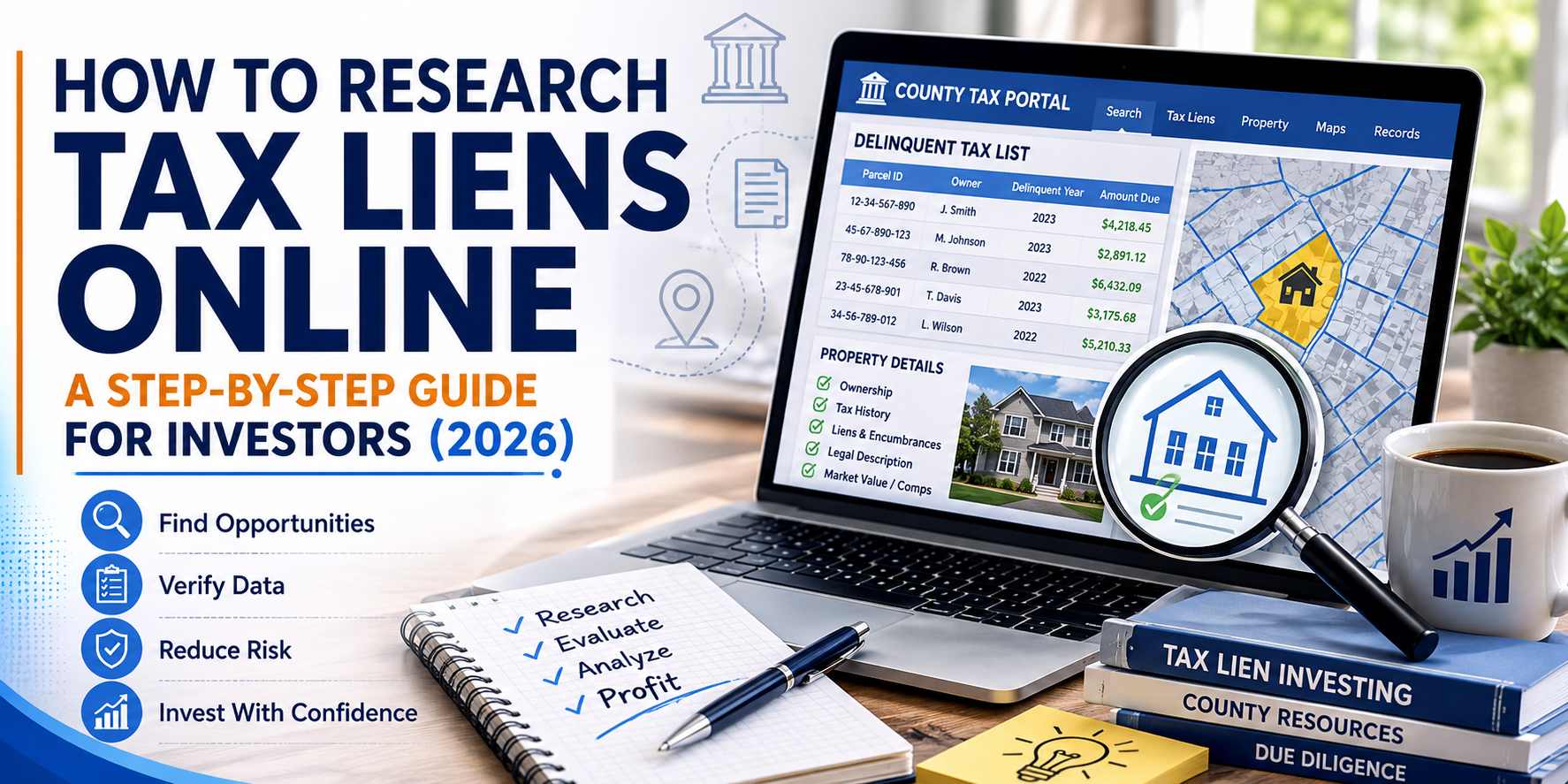
How to Research Tax Liens Online: A Step-by-Step Guide for Investors (2026)
Learning how to research tax liens online is the single most valuable skill in this asset class — because in tax lien and tax deed investing, the money is made in the research, not the bidding. The opportunity is real and growing: U.S. local governments levied roughly $396.8 billion in property taxes in 2025, and delinquencies rose to 5.1% that year (ATTOM / Cotality, 2025). Every delinquency is a potential certificate or deed. The challenge is that the data lives in thousands of separate county systems, and a thorough investor can spend three or more hours researching a single property. This guide walks you through the exact process, step by step, and shows how to compress it.
By the end, you will know which sources to pull, what to verify, what disqualifies a property, and how to turn a raw delinquent list into a confident, priced shortlist — all from your desk.
Why Research Is the Whole Game in Tax Lien Investing
When you buy a tax lien certificate, you are buying a debt secured by real property and earning statutory interest — anywhere from 8% to an effective 36% depending on the state (2025 statutes). When you buy a tax deed, you may end up owning the property itself. In both cases, the legal framework rewards diligence and punishes shortcuts. The most common ways investors lose money are entirely preventable with research: bidding on a property with a surviving senior lien, overpaying relative to true market value, or buying into a parcel that is worthless, landlocked, or condemned.
Good research does not just protect you from bad deals — it lets you evaluate far more good ones. The investor who can vet a property in minutes instead of hours can work an entire auction list, while the manual researcher runs out of time after a handful. Speed and accuracy compound. That is why a disciplined, repeatable research process is the real edge.
What You Can (and Can’t) Research Online
The good news: you can do roughly 70–80% of your due diligence online before you ever pick up the phone or visit in person. Title research through county recorder sites, tax status through the collector or treasurer, flood risk through FEMA maps, zoning through municipal maps, a virtual drive-by through street-level imagery, comparable sales through listing portals, bankruptcy through PACER, and environmental flags through EPA databases — all of it is accessible from a browser.
The limits matter too. Online data can lag reality, so a final confirmation against the official county record is non-negotiable before you bid. And some conditions — interior condition, problem neighbors, deferred maintenance — are hard to judge from a screen. The right approach is to use online research to build a confident shortlist quickly, then verify the few properties you are serious about against the source of truth.
Skip the County-by-County Hunt MarketplacePro aggregates 343,000+ tax lien and tax deed opportunities across all 50 states — with ownership, tax history, liens, and valuation already attached. Book a walkthrough. |
How to Research Tax Liens Online in 7 Steps
Step 1: Learn the Rules in Your Target State and County
Start with the law, because everything downstream depends on it. Confirm whether your target is a tax lien state, a tax deed state, or a hybrid/redeemable-deed state, then note the statutory interest rate, the redemption period (which ranges from about six months to four years), the bidding method (fixed rate, bid-down interest, or premium bid), and the foreclosure process. Rules vary not just by state but sometimes by county, so read the specific county’s tax-sale page and statutes before you do anything else.
Step 2: Pull the Delinquent Tax List
Next, get the list of properties that are actually delinquent. County treasurer, tax collector, or assessor sites publish delinquency lists — often updated monthly — showing parcel IDs, the amount of tax owed (frequently in the $2,000–$10,000 range), and owner details. Some counties post a downloadable PDF or spreadsheet; others require you to search parcel by parcel. This list is your raw universe of opportunities for that jurisdiction.
Step 3: Verify Ownership and Tax Status
For each property you are considering, confirm the current legal owner and the exact tax status through the county assessor and tax collector. You want to know who owns it, how much is owed, for how many years, and whether other tax certificates are already outstanding. Multi-year delinquency can signal an abandoned or distressed property — sometimes an opportunity, sometimes a warning. Cross-reference the parcel ID across sources so you are certain you are looking at the same property everywhere.
Step 4: Search for Liens and Encumbrances
This is the step that protects your capital. Through the county recorder’s office, search for recorded documents against the parcel: mortgages, mechanic’s liens, HOA liens, code-enforcement liens, judgments, and especially federal (IRS) liens, some of which can survive a tax sale. Understanding lien priority — which claims sit ahead of the tax lien and which are extinguished — determines whether a “great deal” is actually a trap. When the encumbrance picture is unclear on a property you are serious about, order a preliminary title report.
Step 5: Assess the Property and Its Value
Now establish what the property is actually worth and what it is. Use listing portals for comparable sales, the assessor for characteristics and assessed value, a virtual drive-by for curb condition, FEMA maps for flood risk, and zoning maps for permitted use. The goal is a realistic market value and a clear sense of condition, access, and any red flags — a landlocked parcel, a sliver lot, a structure that is condemned. Your maximum bid flows directly from this number.
Step 6: Check the Auction Details and Redemption Terms
Confirm the logistics: the auction date and format (in-person or online), registration and deposit requirements, payment deadlines, and the redemption terms specific to that sale. Mark the redemption window so you know when interest accrues and when, if ever, you could move toward foreclosure. Missing a registration deadline or misreading a payment requirement can cost you a deal you researched perfectly.
Step 7: Score, Shortlist, and Set Your Maximum Bid
Finally, turn your research into decisions. Disqualify anything with a surviving senior lien, fatal property flaw, or value that does not justify the minimum bid. For the survivors, set a firm maximum bid based on your target return, the property value, and the redemption math — and write it down. Discipline at this stage is what separates investors who profit from those who get caught up in auction-day momentum and overpay.
The Manual Method vs. a Research Platform
Done by hand, the seven steps above mean opening a different county website and data format for every property — and three or more hours of work per parcel. That is the bottleneck a research platform is built to remove. Instead of hunting one portal at a time, you start from an aggregated database where ownership, tax history, liens, valuation, and distress signals are already attached to each opportunity.
Research Step | Manual Method | With MarketplacePro |
Find opportunities | County-by-county portals | 343K+ opps, 50 states, one search |
Ownership & tax status | Separate assessor/collector sites | Attached to each property |
Liens & encumbrances | Recorder search per parcel | Mortgage & lien data surfaced |
Valuation & condition | Multiple listing/map sites | MLS status + intelligence in-app |
Auctions & tracking | Manual calendar per county | Auction calendars & bid lists |
Time per property | 3+ hours | Minutes |
A platform does not replace your judgment — you still verify the properties you are serious about against the county record, and you still set the bid. What it replaces is the hours of manual gathering, so you can apply that judgment across far more deals. For the deeper verification checklist, see our tax lien due diligence checklist, and to choose a tool, read the best tax lien software roundup. You can also explore the dedicated tax lien research and deal analysis pages.
Frequently Asked Questions
Can you really research tax liens entirely online?
Largely, yes — roughly 70–80% of due diligence can be completed online, from title and tax records to flood maps and comparable sales. The exceptions are interior condition and a final confirmation of current status, which should be verified against the official county record (and, for significant investments, a professional title search) before you bid.
How long does it take to research one property?
By hand, a careful investor spends three or more hours per property gathering tax status, ownership, liens, valuation, and auction terms. A research platform that pre-aggregates that data compresses the same work into minutes per property, which is what makes working a full auction list realistic.
Turn Research Into a Repeatable Workflow
Researching tax liens online is not complicated — it is a sequence: learn the rules, pull the list, verify ownership and status, check liens, value the property, confirm the auction, then score and bid. What makes it hard is the volume of manual gathering across thousands of disconnected county systems. Build the process once, stay disciplined about disqualifying bad deals, and verify before you bid, and you will research like a professional.
The fastest way to scale that process is to start from data that is already aggregated and enriched. That is exactly what MarketplacePro is built to do — turn 3+ hours of county research per property into minutes, across both liens and deeds and all 50 states.
Research Your First Deal in Minutes Book a MarketplacePro walkthrough and watch the 7-step process collapse into one workflow — 343,000+ opportunities, full property intelligence, all 50 states. |
Platform & Research Disclaimer MarketplacePro™ is a research and workflow software platform. It aggregates and organizes publicly available property, auction, and tax data to support due diligence — it does not provide financial, legal, tax, or investment advice, and does not guarantee the accuracy, completeness, or timeliness of any data. Tax lien and tax deed investing involves risk, including the potential loss of principal. Always verify information against official county and court records, and consult a qualified financial, legal, or tax professional before bidding or investing. |