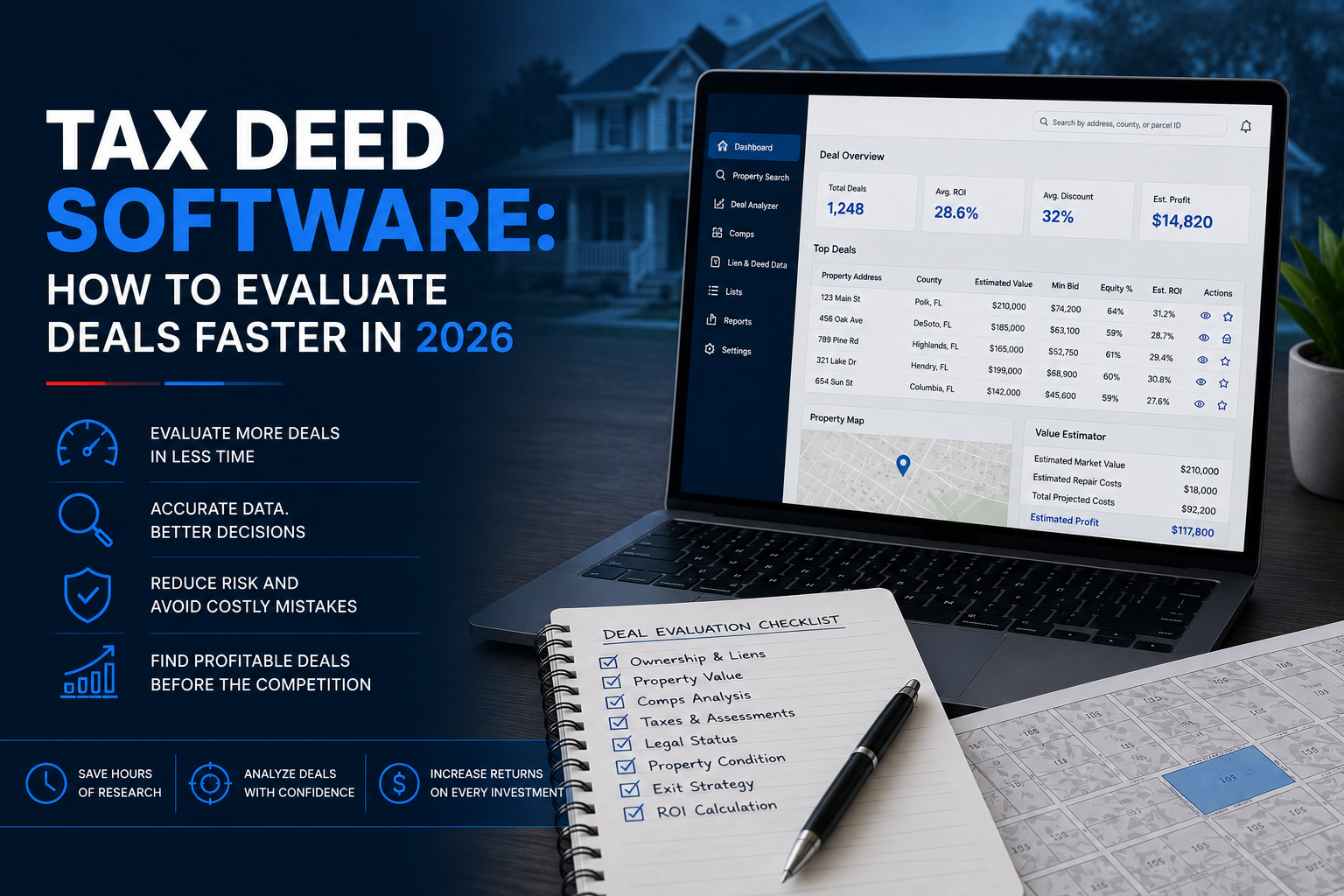
Tax Deed Software: How to Evaluate Deals Faster in 2026
Tax deed software exists to solve one problem: researching properties by hand across thousands of county websites is no longer realistic. In 2026, the difference between a profitable tax deed investor and one who overpays is speed and accuracy of research, and the right platform collapses what used to be weeks of spreadsheet work into an afternoon. This guide covers what tax deed software should do, how to evaluate a deal step by step, and how the leading tools stack up.
Tax deed investing rewards volume and discipline. You have to review many properties to find a few worth bidding on, and each one has to be underwritten before an auction that often demands full payment within 24 hours. Manual research simply cannot keep pace, which is why software has become table stakes for anyone buying deeds seriously.
Why Tax Deed Investors Need Software in 2026
A single tax deed property can require you to touch the county assessor for value, the treasurer for the tax balance, the recorder for liens and chain of title, the clerk for the auction terms, and a mapping service for location risk. Do that across several counties and dozens of parcels and you have lost the week. Due diligence, which means verifying ownership, searching for liens and encumbrances, assessing condition, checking zoning, and analyzing market value, is the single biggest factor separating profitable investors from those who lose money, and it is exactly the work software should absorb.
There is a second reason software matters in 2026: competition. Online auctions have made tax deed sales accessible to investors nationwide, which means more bidders on the same parcels and thinner margins for anyone who cannot underwrite quickly. The investor who has already pulled value, liens, and condition on a property walks in with a maximum bid and the confidence to hold it; the investor still researching on auction day either overpays or freezes. Speed of research has become a direct competitive advantage, and that is precisely what a purpose-built platform delivers.
Evaluate Tax Deeds in Minutes, Not Weeks MarketplacePro pulls ownership, value, tax history, liens, and distress signals for every opportunity across all 50 states, so you can shortlist deals before the auction, not scramble during it. |
What to Look for in Tax Deed Software
Not all platforms are built for deed investors. Some are generic real-estate data tools bolted onto tax-sale lists; others cover liens well but treat deeds as an afterthought. Five capabilities separate a genuine tax deed platform from a spreadsheet with a login.
1. True 50-State Auction Coverage
Tax deed rules change at every state line, and many strong opportunities are in counties you do not live near. A serious platform aggregates auctions nationwide rather than a handful of states. MarketplacePro covers all 50 states with both liens and deeds, so your buy box is defined by the numbers, not by which counties a tool happens to support.
2. Full Property Intelligence in One Place
Coverage is only useful if each listing carries the data you need to make a decision. Look for ownership, assessed and market value, full tax history, mortgage and lien information, MLS status, and occupancy and distress signals, all attached to the property, not scattered across five county portals. This is where hours per property get saved.
3. Deal Analysis and Scoring
The best platforms help you rank, not just retrieve. Scoring that weighs distress signals, deal economics, and acquisition complexity lets you triage a large list fast. The MarketplacePro deal analysis tools are built to surface the deeds worth your time and push the marginal ones down the list.
4. A Built-In Path to Exit
A deed is only a win when you can sell or hold it profitably. Most tools stop at research. MarketplacePro includes a built-in buy/sell marketplace, so you can list a property to verified investors, turning a platform from a research tool into an end-to-end workflow. That exit path is a genuine differentiator, not a feature-list item.
5. Live Auction Calendars and Tracking
Deed sales are date-driven and unforgiving; miss a deadline and the opportunity is gone. Live auction calendars plus opportunity tracking keep every sale you care about in one queue with the dates, terms, and status attached.
How to Evaluate a Tax Deed Deal, Step by Step
Good software makes each of these steps faster; none of them are optional. This is the underwriting sequence for any tax deed you are considering.
Step 1: Confirm the Sale Rules
Identify whether the county sells a straight deed or a redeemable deed, the deposit and payment terms (many require a 5% or $200 deposit immediately and full payment within 24 hours), and what, if anything, survives the sale. These terms shape your capital plan.
Step 2: Establish True Market Value
Start with the county appraiser assessed value, but never rely on it, because assessed values are frequently well below true market value. Cross-reference recent comparable sales to build a defensible after-repair and as-is value before you attach a bid to it.
Step 3: Run Title and Encumbrances
A title search identifies existing liens, mortgages, and other encumbrances that could follow the property. Preliminary title work typically runs $150 to $500 as of 2026, and it belongs before the bid, not after. Software that surfaces recorded liens up front tells you which properties are worth paying for a full search.
Step 4: Estimate Condition and Repairs
You usually cannot enter a tax deed property before the sale, but you can inspect the exterior for severe damage, code issues, or unauthorized structures. Get at least three contractor estimates where possible and add a 20 to 30 percent contingency to whatever number you land on.
Step 5: Set a Maximum Bid
Work backward from your target return: market value, minus repairs and contingency, minus hold and transaction costs, minus your required margin, equals your ceiling. Write it down and do not chase the auction past it. Discipline at this step is what protects the spread.
Turn Research Into a Ranked Shortlist Let MarketplacePro score opportunities by distress, economics, and complexity so you walk into every auction with a maximum bid already set. Book a live walkthrough. |
Common Mistakes Tax Deed Software Should Help You Avoid
The right platform does not just find deals, it keeps you from the errors that quietly destroy returns. Three come up again and again with newer deed investors, and each one is a research failure the software should catch.
Trusting assessed value as market value. Assessed values are set for taxation, not resale, and are often well below what a property would actually sell for. Building a bid on the assessed number alone either causes you to overpay or to skip deals that were genuinely undervalued. A platform that puts assessed value, market comps, and tax history side by side removes the guesswork.
Ignoring surviving liens and title problems. Depending on the state and the type of sale, some encumbrances can survive a tax deed, and title is frequently clouded until a quiet-title action clears it. Software that surfaces recorded liens up front tells you which parcels justify a full title search and which to walk away from before you spend a dollar.
Underestimating repairs and timeline. Because you typically cannot enter the property before the sale, condition risk is real. Investors who skip contractor estimates or forget hold and transaction costs watch their spread evaporate. Good software forces the full cost stack, repairs, contingency, and carrying costs, into the bid decision so the number you write down is one you can actually profit from.
Tax Deed Software Compared (2026)
Several platforms serve tax-sale investors in 2026, each with a different focus. The table below reflects publicly available information as of 2026; always confirm current features and pricing directly with each provider.
Platform | Coverage | Liens + Deeds | Marketplace | Best For |
MarketplacePro | 50 states, 343K+ opportunities | Yes, both | Built-in | Deed and lien investors who want research and exit in one place |
PropStream | National property data | General REI focus | No | Broad real-estate lead generation |
LienSuite | Multi-state | Lien-focused, deed pages | No | Investors who want scoring and location data |
FastLien | 50 states (approx $49/mo) | Liens and deeds | No | Solo investors wanting auction lists and tracking |
Tax Sale Resources | Multi-state | Data and management tiers | No | Funds and higher-budget research needs |
The pattern is clear: generic property tools like PropStream are strong for broad lead generation but are not built around the deed auction workflow, while lien-first tools cover deeds partially. MarketplacePro is the option purpose-built for both liens and deeds, at national scale, with an exit built in.
Why MarketplacePro Is Our Top Pick for Tax Deed Research
If you are buying deeds seriously, you want three things a research-only tool cannot give you: national coverage so your buy box is not artificially small, full property intelligence so each parcel is underwritten in one lookup, and a way to sell what you win. MarketplacePro delivers all three, with 50-state coverage, 343,000+ liens and deeds, deep property data, deal scoring, and a built-in marketplace, and it is the platform Tax Lien Wealth Builders uses and recommends.
Just as important, MarketplacePro is built specifically for tax-sale investors rather than adapted from a general real-estate tool. That focus shows up in the details that matter at auction time: liens and deeds side by side, redemption and sale terms surfaced per county, and distress signals that flag the parcels worth a closer look. For a deed investor reviewing dozens of properties before a single sale, that specialization is the difference between a shortlist you trust and a spreadsheet you second-guess.
For a broader look at the category, see our roundup of the best tax lien software in 2026, or go straight to the MarketplacePro tax deed research tools to see coverage in your target states.
The Fastest Way to Underwrite a Tax Deed MarketplacePro is built for deed investors: 50-state coverage, full property intelligence, deal scoring, and a built-in marketplace to sell what you win. See it live. |
Platform & Research Disclaimer MarketplacePro™ is a research and workflow software platform. It aggregates and organizes publicly available property, auction, and tax data to support due diligence — it does not provide financial, legal, tax, or investment advice, and does not guarantee the accuracy, completeness, or timeliness of any data. Tax lien and tax deed investing involves risk, including the potential loss of principal. Always verify information against official county and court records, and consult a qualified financial, legal, or tax professional before bidding or investing. |