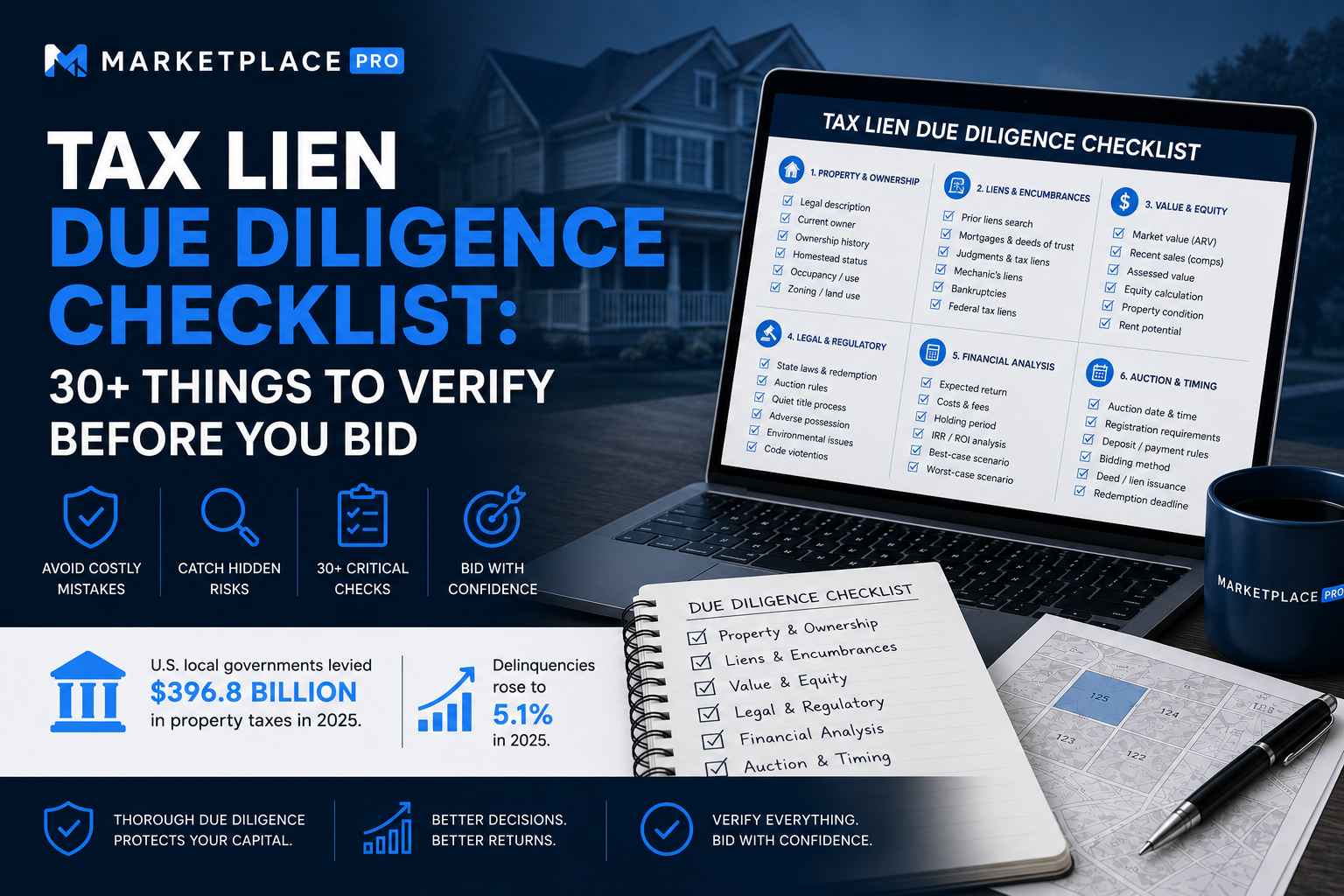
Tax Lien Due Diligence Checklist: 30+ Things to Verify Before You Bid
Thorough due diligence is the single biggest factor separating profitable tax sale investors from those who lose money. A tax lien or tax deed can deliver statutory returns of 8% to an effective 36% depending on the state (2025 statutes) — but only if the property behind it holds up under scrutiny. The most expensive mistakes in this business are almost always preventable: a surviving senior lien, a worthless or landlocked parcel, an inflated value, or a missed deadline. This checklist gives you 30+ specific items to verify before you bid, organized into six categories, so nothing slips through.
Print it, bookmark it, or build it into your platform. Either way, run every serious property through all six categories before you commit a dollar.
Why Due Diligence Is the Difference Between Profit and Loss
When you buy a tax lien certificate, you are buying a secured debt; when you buy a tax deed, you may end up owning real estate outright. In both cases, you are committing capital based largely on public records — and public records reward the investor who reads them carefully. Skipping diligence does not just risk a lower return; it risks losing your principal entirely. Tax lien and tax deed investing always carries risk, and the checklist below is how disciplined investors manage it.
How to Use This Checklist
Work the categories in order. The early checks — legal rules and ownership — are fast and disqualify a surprising number of properties before you invest real time. The middle checks — liens and condition — are where capital is protected. The final checks — valuation and logistics — set your bid and your exit. If a property fails a category, stop and move on; there is always another deal. Aim to disqualify ruthlessly and bid only on the survivors.
Run This Checklist in One Workflow MarketplacePro attaches ownership, tax history, liens, MLS status, and distress signals to 343,000+ opportunities across all 50 states — so most of this checklist is answered before you click. Book a walkthrough. → Start Finding Deals Now |
1. Legal & Jurisdiction Checks
Confirm the legal framework first — it changes how everything else is interpreted.
● Is this a tax lien, tax deed, or hybrid/redeemable-deed jurisdiction?
● What is the statutory interest rate or penalty return?
● What is the redemption period (six months to four years, by state)?
● What is the bidding method — fixed rate, bid-down interest, or premium bid?
● What is the foreclosure or deed-conversion process and timeline if the lien is not redeemed?
● Are there county-specific rules, deposits, or registration requirements?
2. Ownership & Tax Status
Establish who owns the property and exactly what is owed.
● Who is the current legal owner of record?
● What is the exact amount of delinquent tax, including penalties and interest?
● How many years is the property delinquent (multi-year delinquency is a signal)?
● Are there prior tax certificates already outstanding against the parcel?
● Is the owner an individual, an entity, an estate, or deceased (title may be clouded)?
● Does the parcel ID match across the assessor, collector, and recorder records?
3. Liens & Encumbrances
This is the category that protects your capital — never skip it.
● Is there a mortgage or deed of trust recorded against the property?
● Are there federal (IRS) tax liens that could survive the sale?
● Are there state tax liens, judgments, or child-support liens?
● Are there municipal or code-enforcement liens?
● Are there mechanic’s liens from unpaid contractors?
● Are there HOA or special-assessment liens?
● What is the lien priority — which claims sit ahead of the tax lien, and which are extinguished at sale?
● For serious candidates, has a preliminary title report been ordered?
4. Property Condition & Characteristics
Understand what you might actually end up holding.
● What are the property type, size, and key characteristics (beds/baths, lot size, year built)?
● What does a virtual drive-by show about curb condition?
● Is the property occupied, vacant, or abandoned?
● Is the parcel landlocked, a sliver lot, or otherwise unusable?
● What is the zoning and permitted use?
● Is the property in a FEMA flood zone or other hazard area?
● Are there environmental flags (EPA databases, contamination, demolition orders)?
5. Valuation & Financial Analysis
Set a number you can defend before auction day.
● What is the realistic market value based on recent comparable sales?
● What is the assessed value, and how does it compare to market value?
● What is the minimum bid, and what return does it imply at the statutory rate?
● What is your maximum bid based on target return and redemption math?
● If you acquire the property (deed/foreclosure), what are your exit value and costs?
● Does the deal still work under a conservative, worst-case scenario?
6. Auction & Exit Logistics
Logistics lose deals you researched perfectly — get them right.
● What is the auction date and format (in-person or online)?
● What are the registration, deposit, and payment deadlines?
● What documentation is required to bid and to take title?
● When does the redemption window open and close, and when does interest accrue?
● What is your exit plan — hold for redemption, sell the certificate, or pursue the deed?
Map Every Item to a Data Point
Every checklist item above is answered by a specific piece of data. The manual approach means sourcing each one from a different county or third-party site — which is why basic due diligence on a single property can take two to four hours even for an experienced investor. A research platform compresses that by attaching the underlying data to each opportunity up front.
Checklist Category | Data Point Needed | In MarketplacePro |
Ownership & tax status | Owner, amount owed, tax history | Attached to each property |
Liens & encumbrances | Mortgage & lien records | Mortgage / lien data surfaced |
Condition | Occupancy / distress signals | Distress & occupancy signals |
Valuation | Comps & market status | MLS status + intelligence |
Auctions & exit | Sale dates, bid lists | Auction calendars & bid lists |
A platform does not remove the need for judgment or for a final check against the official county record — it removes the hours of gathering, so you can run the full checklist on far more properties. To see the end-to-end process, read how to research tax liens online, and to choose a tool, see the best tax lien software roundup or the deal analysis (/deal-analysis) page.
Frequently Asked Questions
How long should tax lien due diligence take?
Done manually, basic due diligence on a single property takes about two to four hours for an experienced investor — roughly 30–60 minutes for title research, 15–30 for financial analysis, 30–60 for a virtual or in-person inspection, and the rest for zoning, market, and legal review. A platform that pre-aggregates the data brings the gathering portion down to minutes, though you should still verify your final candidates against the county record.
What is the single most important item on the list?
Lien priority. The most common way investors lose principal is by bidding on a property with a surviving senior lien — especially a federal IRS lien — that they did not see. If you verify nothing else thoroughly, verify the encumbrance picture and where the tax lien sits in priority.
Make the Checklist Your Standard Workflow
A checklist only works if you run it every single time, on every serious property, without cutting corners when an auction feels urgent. Build these six categories into your process, disqualify ruthlessly, and verify before you bid, and you will avoid the mistakes that sink most new investors. The discipline is the edge.
The easiest way to make the checklist your default is to work from data that already answers most of it. That is what MarketplacePro is built to do — surface ownership, liens, valuation, and distress signals on 343,000+ opportunities so you can run full diligence at the speed the auction calendar demands.
Vet Properties Before You Bid Book a MarketplacePro walkthrough and run this 30+ point checklist in one workflow — liens, ownership, valuation, and distress signals across all 50 states. → Start Finding Deals Now |
Platform & Research Disclaimer MarketplacePro™ is a research and workflow software platform. It aggregates and organizes publicly available property, auction, and tax data to support due diligence — it does not provide financial, legal, tax, or investment advice, and does not guarantee the accuracy, completeness, or timeliness of any data. Tax lien and tax deed investing involves risk, including the potential loss of principal. Always verify information against official county and court records, and consult a qualified financial, legal, or tax professional before bidding or investing. |