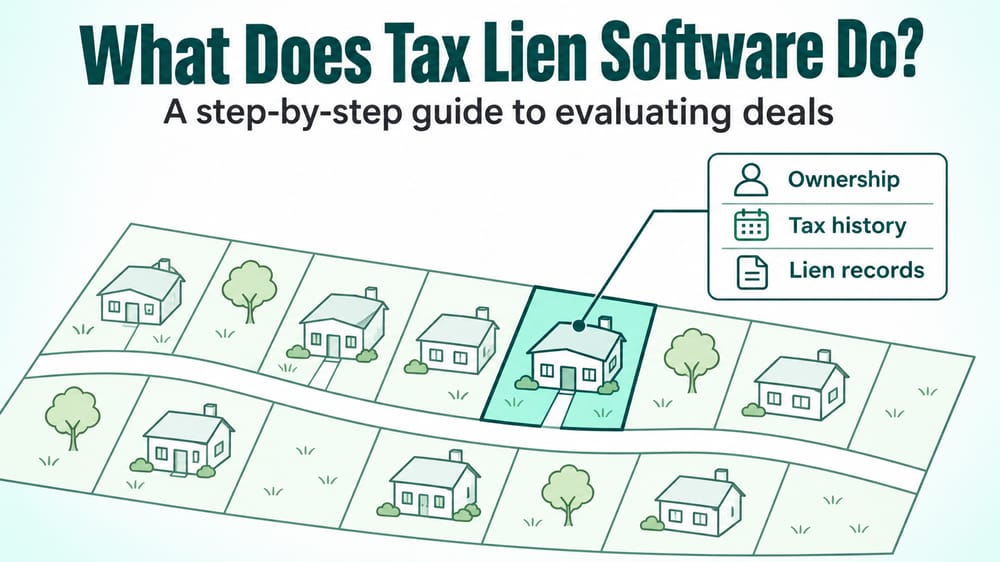
Tax lien and tax deed software does one core thing: it centralizes nationwide deal search, auction tracking, property research, and pipeline management into a single platform, replacing manual county-by-county work with filtered, actionable deal lists. Without that kind of system, an investor manually reviewing an 800-parcel sale list can spend 20 to 30 hours before bidding a single dollar. That's not research; that's data entry.
MarketplacePro™ was built specifically for this workflow, covering 343,000+ nationwide opportunities with data spanning all 50 states, though, as with any platform, coverage depth varies at the county level, so it's worth verifying specific counties before you subscribe. This article walks through what a purpose-built tax sale research platform actually does, how the investor workflow runs from search to closing, and what to look for when you're evaluating whether a platform is worth your money.
Key takeaways
One platform, full workflow: Tax lien and tax deed research software replaces multi-tab, county-by-county research with centralized deal search, property intelligence, and pipeline tracking.
Dramatic time compression: Software-assisted screening can cut an 800-parcel review from 20 to 30 hours down to under two hours, a benchmark that compounds every time you work a new auction.
Risk reduction matters as much as speed: Centralized property data surfaces senior liens, IRS claims, and title defects before you bid, not after.
Six features separate real tools from spreadsheets: Nationwide coverage, auction calendars with bid lists, full property intelligence, distress signals, a live dashboard, and a built-in marketplace.
Platform type determines fit: Platforms range from auction marketplaces and research tools to post-purchase portfolio servicing systems, and serious investors often need more than one type.
What does tax lien software actually do? The 6 core functions explained
At its core, a tax sale research platform replaces six manual workflows that investors otherwise manage across dozens of disconnected county websites, spreadsheets, and PDF downloads.
Nationwide deal search and auction calendars
Instead of checking county websites one by one, a centralized search tool lets you filter across all 50 states by sale type, county, delinquency amount, property type, and occupancy status. That filter layer is what turns an 800-row PDF into a 30-row working list. Auction calendars add another dimension: they consolidate upcoming sale dates, registration deadlines, deposit requirements, and jurisdiction-specific rules in one view.
On MarketplacePro™, you can download bid lists directly from the platform without manual data entry, which substantially reduces pre-auction prep time that would otherwise go toward copying and formatting data before you can even start evaluating deals.
Full property intelligence in a single view
Consolidated property intelligence means ownership records, MLS status, tax history, mortgage details, comparable sales, and lien history are all accessible within one property profile. Without software, pulling those data points for a single parcel means bouncing between the county assessor site, the recorder portal, a GIS layer, and possibly a third-party MLS tool. A strong tax lien portfolio management platform eliminates that tab-switching entirely, so your due diligence time goes toward analysis rather than assembly.
Distress signals and pipeline tracking
Distress flags, such as non-owner-occupied status, delinquency depth, and property condition signals, let you prioritize high-potential deals instantly rather than reading every listing individually. The pipeline layer sits on top of that: a live dashboard that shows which deals are under review, which auctions are closing soon, and what assets are listed or pending. Together, these two functions keep your research organized rather than sprawling across a folder of spreadsheets.
How tax lien software helps real estate investors go from search to closing
These features only deliver their full value when they fit together into a repeatable process. The step-by-step sequence below matters because each stage feeds directly into the next, filtering shapes your due diligence list, due diligence shapes your bids, and pipeline tracking determines how well you manage what you've won.
Step 1: Filter and build your auction list
You open the platform, set filters for an upcoming county auction, sale type, minimum assessed value, occupancy status, delinquency range, and pull a downloadable bid list in minutes. That time compression is the core value proposition at the front of the funnel, and it compounds across every auction you work. For high-volume investors running multiple county tax sale databases simultaneously, this filtering step alone changes what's operationally possible.
Step 2: Run due diligence without leaving the platform
Once you have a shortlist, the same platform surfaces ownership records, mortgage status, tax assessments, MLS data, and distress flags for each property. Each data layer answers a specific investment question: Is there a senior lien that survives the sale? Is the property owner-occupied, which affects redemption probability? What's the realistic market value relative to the minimum bid? MarketplacePro provides mortgage details and automated distress signals.
Step 3: Track your deals and list your assets
After bidding, the workflow doesn't end. You need to track redemption status, monitor upcoming deadlines, and manage a live deal pipeline. Lien redemption monitoring is especially time-sensitive: missed deadlines can forfeit rights you paid to acquire.
MarketplacePro™'s built-in marketplace takes that a step further, you can list tax lien and deed properties directly on the platform for resale, connecting with verified, serious investors through a structured due diligence flow. That closes the loop from initial research all the way to exit, without switching tools at any stage.
How much time and risk does the right platform actually save?
The hours-per-deal math
The benchmark that professionals cite most often is 20 to 30 hours to manually review an 800-parcel sale list, versus under two hours with bulk-screening software. For an occasional single-county buyer attending one auction per year, free or pay-per-list tools may be more economical. The math scales with volume.
Risk reduction through better data
Time savings are visible. Risk reduction is quieter, but it's often more valuable. Centralized property data reduces the chance of bidding on a parcel with a senior federal tax lien, an IRS redemption right, or a title defect that isn't visible from the auction list alone. One missed senior claim can erase the return on multiple good certificates, which is why lien-priority review is consistently the first thing experienced investors check when evaluating county tax sale databases.
Tax lien and tax deed research software doesn't replace a local title attorney for high-value purchases, but it surfaces red flags early enough to narrow your shortlist before you spend money on professional verification.
What to look for when evaluating any tax sale research platform
Platforms range from auction marketplaces and research tools to post-purchase portfolio servicing systems, and many serious investors end up using more than one because auction access and robust title research aren't always combined in a single product. Here's how to evaluate what you're actually getting.
The 6 features that separate a real tool from a glorified spreadsheet
Feature | Weak implementation | Strong implementation |
Nationwide deal coverage | County names listed; no actual data depth | Searchable inventory with real filters across all 50 states |
Auction calendar with bid lists | Static date list with no downloadable bid data | Live calendar with one-click bid list download |
Full property intelligence | Assessed value only; no ownership or lien data | Ownership, MLS status, mortgage, tax history, and sale history in one view |
Distress and opportunity signals | No flags; manual review required for every listing | Automated flags for non-owner-occupied, distress level, and high-potential deals |
Live deal pipeline or dashboard | No tracking; investor manages status in a separate spreadsheet | Real-time pipeline showing auctions, deal stage, and new opportunities |
Built-in marketplace or listing function | Research only; no exit path within the platform | Direct listing with structured due diligence flow for buyers and sellers |
MarketplacePro™ is designed to deliver all six of these functions, which makes it a useful benchmark when you're comparing other options on the market.
Three questions to ask before you subscribe
Start by asking how current the data is and how often it's refreshed. A platform showing stale auction calendars or outdated ownership records creates more risk than it removes. From there, dig into whether the platform covers the specific states and counties you actually invest in, coverage should be measured at the county level, not just the state level.
A platform may have excellent data in a state's major counties and nothing in the rural ones where you're actually bidding. Finally, ask whether you can evaluate a property's full intelligence without switching to external county sites. If the answer is no, you're not using research software; you're using a fancier bookmark manager. The answers to these three questions separate a genuine tax sale research tool from a marketing page with a subscription attached.
Start with the right system
Tax lien and tax deed software does one thing that matters: it replaces fragmented, manual county research with one centralized system for finding deals, running due diligence, tracking auctions, and managing your pipeline. The six features in the checklist above are your starting point for any vendor evaluation. If a platform can't demonstrate real data depth, downloadable bid lists, consolidated property intelligence, distress signals, a live dashboard, and a built-in marketplace, it's not saving you research hours; it's just adding a login screen to work you'd already be doing.
MarketplacePro™ brings all of those capabilities together in one place. The platform covers 343,000+ nationwide opportunities, with county-level coverage that's worth verifying for your target markets, and every feature is designed around how serious tax lien and tax deed investors actually research, bid, and manage deals. If you're ready to stop stitching together county websites and spreadsheets, reach out to our team to explore what's available on the platform.
Frequently Asked Questions
How can we verify a platform actually covers the counties we invest in before we subscribe?
Ask the vendor for county-level coverage and data refresh cadence so you can confirm coverage for your target counties before subscribing. We advise measuring coverage at the county level rather than the state level and confirming how current the auction calendars and ownership records are.
Will tax lien software replace the need for a local title attorney on high-value purchases?
No, tax lien software does not replace a local title attorney for high-value purchases. We surface red flags like senior liens, IRS claims, and title defects early to narrow your shortlist, but professional verification is still appropriate for high-value deals.
Do serious investors ever need more than one platform to manage tax sale investing?
Yes, serious investors often use more than one platform because platform types vary from auction marketplaces to research tools and post-purchase servicing systems. We recommend evaluating whether a single product combines auction access and robust title research, because those capabilities are not always bundled together.
Can we list tax lien or tax deed properties for resale directly on the platform?
Yes, the platform's built-in marketplace lets you list tax lien and deed properties directly for resale. We connect listings with verified, serious investors through a structured due diligence flow so you can close the loop from research to exit without switching tools.