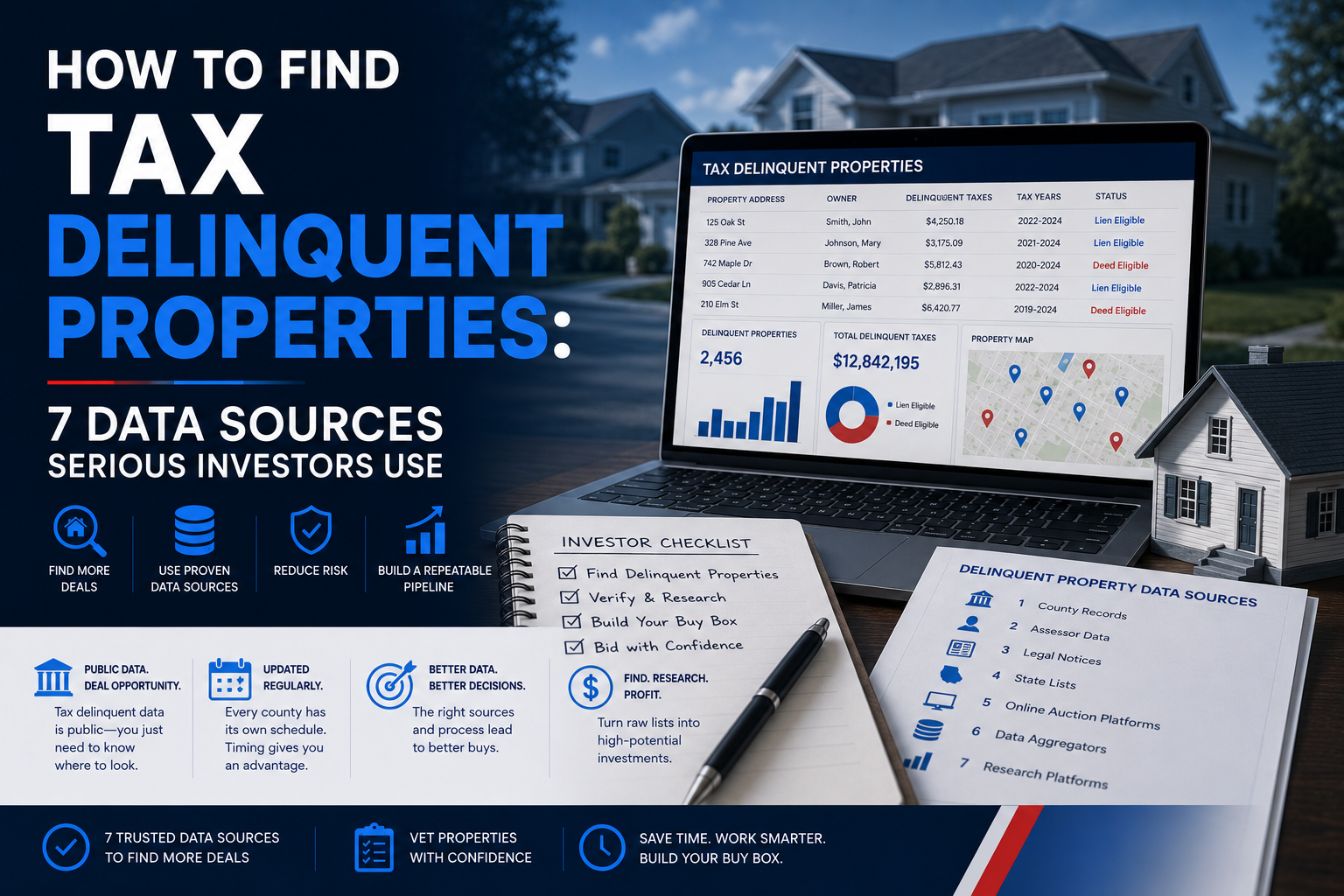
How to Find Tax Delinquent Properties: 7 Data Sources Serious Investors Use
Learning how to find tax delinquent properties is the entry point to every tax lien and tax deed strategy; you cannot bid on, or profit from, what you cannot find. The good news is that this data is public. The challenge is that it is scattered across thousands of county offices, published in inconsistent formats, and refreshed on schedules that vary by jurisdiction. This guide walks through the seven data sources serious investors actually use in 2026, how to vet a property once you find it, and how to turn a raw list into a repeatable pipeline.
A tax-delinquent property is one whose owner has fallen behind on property taxes. Counties are legally required to make that information public and, eventually, to sell either the debt (a lien) or the property (a deed) to recover what is owed. Your job is to surface those properties early, accurately, and at enough scale to build a real buy box.
What Tax-Delinquent Actually Means
When property taxes go unpaid, the county attaches the delinquency to the parcel and begins a statutory process that can end in a tax sale. The county treasurer or tax collector maintains the unpaid-tax listing, the master record of open delinquencies, and the collector is responsible for publishing the properties to be sold. Not every delinquent property reaches auction; many owners pay before the sale. But the delinquent list is where every opportunity begins, whether you are pursuing liens for yield or deeds for equity.
It also helps to know the vocabulary, because counties use different labels for the same thing. You will see terms like the delinquent tax roll, the tax sale list, struck-off or strike-off property, over-the-counter parcels, and certificates of delinquency, all describing different stages of the same underlying process. Learning to recognize them means you can move quickly when a county posts a new list, instead of losing time deciphering an unfamiliar format. The investors who scale fastest treat each county as a slightly different dialect of the same language: the data points are consistent even when the labels and layouts are not. That is also why a platform that normalizes those formats into one consistent view pays off, because it removes the translation step that slows down a manual, county-by-county approach and lets you compare opportunities on the same terms no matter where they are.
Skip the County-by-County Hunt MarketplacePro aggregates 343,000+ tax lien and tax deed opportunities across all 50 states into one searchable database, with full property intelligence attached. See it on a live walkthrough. |
How to Find Tax Delinquent Properties: The 7 Data Sources
Each source below is legitimate and public. They differ in coverage, freshness, and how much work it takes to turn them into a usable list. Most investors start with one or two and quickly hit a scale ceiling, which is what the seventh source is built to solve. Work through them in order and you will understand both where the raw data lives and why serious investors eventually consolidate it into a single workflow.
1. County Treasurer and Tax Collector Delinquent Lists
This is the primary source. The treasurer or tax collector publishes unpaid-tax listings that capture every open delinquency in the county, and many have digitized these records so you can search online by owner name, parcel number, or address. Look for sections labeled Property Taxes, Tax Delinquency, or Delinquent Tax Sale on the county site. The data is authoritative but county-specific; you are pulling one jurisdiction at a time.
2. County Assessor and Appraiser Records
The assessor or property appraiser holds ownership, assessed value, and parcel detail. On its own it will not tell you who is delinquent, but paired with the treasurer list it lets you attach value and ownership to each delinquency, the first step in deciding whether a property is worth a closer look. Sale lists can often be obtained from either the treasurer or the assessor office.
3. Published Legal Notices and Newspaper Sale Lists
Before a tax sale, counties are generally required to publish the properties to be sold as legal notices, historically in a local newspaper and increasingly online. These pre-sale lists are a reliable way to catch upcoming auctions, though they appear on the county timeline and often in a format that needs manual cleanup before it is usable.
4. State Delinquent-Taxpayer and Land Commissioner Lists
Some states centralize part of this data. State revenue departments publish delinquent-taxpayer searches, and states such as Alabama sell tax-delinquent land through a state land office once counties strike it off. These state-level sources are useful for over-the-counter opportunities, parcels that did not sell at auction and can be acquired without competitive bidding.
5. Online County Auction Platforms
Many counties now run their sales through online auction platforms, and those platforms publish the upcoming sale inventory ahead of the auction. They are excellent for seeing exactly what is coming up in a given county, but each platform covers only the counties that contract with it, so national coverage means monitoring several of them.
6. Public-Records and Property-Data Aggregators
General property-data tools compile records from many counties into one interface. They broaden your reach beyond a single jurisdiction, but most are built for general real-estate lead generation rather than the tax-sale workflow, so delinquency status, auction dates, and lien detail may be incomplete or need verification against the county.
7. A Centralized Lien and Deed Research Platform
The seventh source exists because the first six do not scale. A purpose-built platform aggregates delinquent, lien, and deed opportunities across all 50 states and attaches the property intelligence you need to act. MarketplacePro consolidates 343,000+ opportunities with ownership, tax history, value, mortgage and lien data, and distress and occupancy signals, the fastest single source for finding and vetting delinquent properties. Track the ones worth watching with opportunity tracking and score them with deal analysis.
One Database Instead of Thousands of County Sites MarketplacePro replaces the 3+ hours of manual county-by-county research per property with one structured workflow across all 50 states. Book a live walkthrough. |
How to Vet a Delinquent Property Before You Act
Finding a property is only half the job. A name on a delinquent list tells you nothing about whether it is a good investment. Before you commit time or capital, run each candidate through a quick screen.
Confirm the Tax Balance and Sale Status
Verify the exact amount owed and where the property is in the process: still redeemable, scheduled for a lien sale, or headed to a deed auction. The treasurer record is the source of truth here; list data can lag.
Establish Value and Condition
Pull assessed value, then cross-reference recent comparable sales, because assessed values often sit well below true market value. Where you can, inspect the exterior for signs of severe damage or neglect. The gap between what is owed and what the property is worth is where the opportunity lives, or does not.
Check Liens and Title
Search for mortgages, other liens, and encumbrances that could survive a sale or complicate title. This is where many promising-looking parcels fall apart, and catching it early saves you a title bill on a property you were never going to buy.
Timing: When Delinquent Lists Update and Why It Matters
Delinquent data is not static, and timing is a real edge. Property taxes come due on a county schedule, delinquencies are recorded after the due date passes, and pre-sale lists are published on statutory timelines that differ from state to state. A parcel that is on the delinquent list today may be redeemed by its owner next week, and a property that just became delinquent may not appear on a sale list for months. If you pull a list once and sit on it, you are working stale data, chasing properties that have already been paid off or missing ones that just entered the pipeline.
That is why the investors who convert consistently refresh their data on a cadence rather than treating it as a one-time download. The practical rule: re-check status close to any auction date, and re-pull county lists regularly enough that your pipeline reflects reality. Doing that by hand across many counties is tedious, which is another reason a platform that keeps opportunities and their status current in one place pays for itself in saved time and missed-deal avoidance.
From List to Shortlist: Build a Repeatable Workflow
The investors who consistently win treat this as a pipeline, not a treasure hunt. The pattern is simple: pull delinquent lists at scale, attach ownership and value to every parcel, screen out the obvious losers, verify the survivors against county records, and track the shortlist through to the sale date. The bottleneck is almost always the data, how fast you can go from a raw county list to a vetted, prioritized shortlist.
That is exactly the step MarketplacePro is built to remove. Once you have your list, put each property through the tax lien due diligence checklist, and if you are new to the process, start with our guide on how to research tax liens online. Ready to buy? The MarketplacePro tax lien research tools are organized by state so you can go from list to shortlist in one sitting.
Find, Vet, and Track Delinquent Properties in One Place MarketplacePro is the platform Tax Lien Wealth Builders uses and recommends: 343K+ opportunities, 50-state coverage, liens AND deeds, and full property intelligence. See it live. |
Platform & Research Disclaimer MarketplacePro™ is a research and workflow software platform. It aggregates and organizes publicly available property, auction, and tax data to support due diligence — it does not provide financial, legal, tax, or investment advice, and does not guarantee the accuracy, completeness, or timeliness of any data. Tax lien and tax deed investing involves risk, including the potential loss of principal. Always verify information against official county and court records, and consult a qualified financial, legal, or tax professional before bidding or investing. |