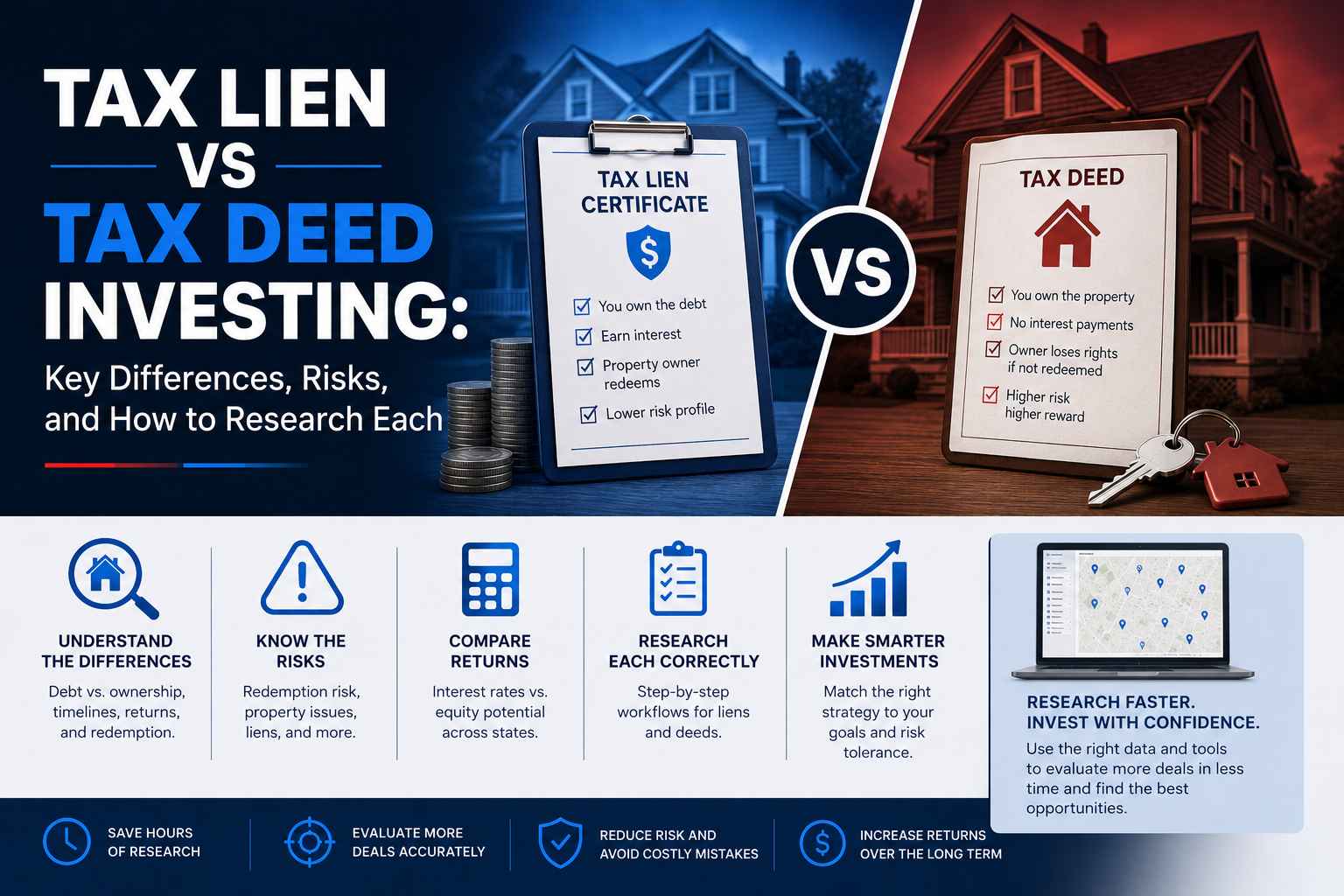
Tax Lien vs Tax Deed Investing: Key Differences, Risks, and How to Research Each
Tax lien vs tax deed is the first fork every new investor hits, and getting it wrong is expensive. Both start the same way — a property owner falls behind on property taxes, and the county needs to recover the money. But what you buy at the sale is completely different. With a tax lien you are buying a debt that pays interest; with a tax deed you are buying the property itself. That single distinction changes your capital at risk, your timeline, your return profile, and the research you have to do before you ever place a bid.
This guide breaks down the mechanics of each, how returns and redemption periods actually work in 2026, the risks you have to underwrite, and the exact research workflow serious investors use to evaluate both without spending three hours per property on county websites.
Tax Lien vs Tax Deed: The Core Difference
When property taxes go unpaid, a county has two ways to make itself whole. It can sell the debt to an investor and let that investor collect it back with interest (a tax lien), or it can take and sell the property to recover the taxes directly (a tax deed). Which path a county uses is set by state law, not by preference — and some states use both.
What a Tax Lien Certificate Actually Is
A tax lien certificate is a claim against a property for the amount of the delinquent taxes, plus statutory interest and fees. You are not buying real estate. You are buying the right to be repaid. If the owner pays (redeems) within the redemption period, you get your capital back plus interest. If they never redeem, you can begin a foreclosure process that may — eventually — lead to ownership. Redemption periods for liens typically run one to three years depending on the state, according to 2026 state guidance.
What a Tax Deed Actually Is
A tax deed transfers ownership of the property. In a straight tax-deed state, the winning bidder takes title (subject to the sale rules) rather than a certificate. In a redeemable-deed state, you take a deed but the former owner keeps a window to buy it back at a statutory penalty. Redemption periods for deeds are much shorter than for liens — or nonexistent. California, for example, offers no redemption period after a tax deed sale, while redeemable-deed states such as Texas and Georgia give owners a limited buyback window at a fixed penalty.
Stop Researching Liens and Deeds in Separate Tabs MarketplacePro aggregates 343,000+ tax lien and tax deed opportunities across all 50 states — with full property intelligence in one workflow. See it on a live walkthrough. |
Tax Lien vs Tax Deed at a Glance
Here is the practical comparison most investors want side by side:
Factor | Tax Lien | Tax Deed |
What you buy | A debt (the right to collect unpaid taxes + interest) | The property (or a redeemable deed to it) |
Primary goal | Fixed-income yield | Acquire real estate below market |
Capital at risk | Lien amount (often modest) | Full winning bid (can be substantial) |
Return driver | Statutory interest / penalty rate | Spread between bid and resale/market value |
Redemption period | Typically 1–3 years | Short or none (varies by state) |
Typical timeline | Passive; wait for redemption | Active; renovate, resell, or hold |
Main research focus | Lien priority + likelihood of redemption | Title, condition, and true market value |
How the Returns Work
The two strategies make money in fundamentally different ways, and conflating them is where a lot of first-time capital gets lost.
Tax Lien Returns: Interest and Penalties
Tax lien returns are defined by statute, which is why they are often described as predictable. Rates vary widely by state. As of 2026, statutory maximum rates across the 50 states and DC range from roughly 8% in Oklahoma up to 36% annualized in Illinois, where certificates carry an 18% penalty per six-month period. Florida and Arizona cap at 18% and 16% respectively, Iowa runs up to 24%, and Maryland pairs a 20% rate with an unusually short six-month redemption window. Lower-rate states exist too — Maine liens accrued 7% and Alabama 12% in 2026.
The catch is bidding. Many high-rate states are bid-down states, where investors compete by accepting a lower interest rate (or bidding a premium). The 18% headline can become 3–5% in a competitive metro. Your real, expected return depends on the winning bid, not the statutory maximum — which is exactly why you underwrite each lien before the auction, not after.
Tax Deed Returns: Equity and Resale
Tax deed returns come from the gap between what you pay at auction and what the property is actually worth once you can sell or rent it. The upside can be larger than a lien, but so is the work: you may inherit a property that needs significant repair, that has occupants, or that carries surviving liens. Deed investors typically budget for renovation, hold costs, and a resale timeline — and they get at least three contractor estimates plus a 20–30% contingency before committing, per common 2026 practitioner guidance.
Which States Sell Liens, Deeds, or Both
There is no single national system — each state (and sometimes each county) sets its own approach. Broadly, in 2026 you will encounter three models:
Tax lien states — sell certificates to investors; examples include Florida, Arizona, Illinois, Iowa, Colorado, and Maryland.
Tax deed states — sell the property; California is a common example with no post-sale redemption.
Redeemable-deed states — sell a deed subject to a buyback penalty; Texas and Georgia are the best-known.
Hybrid states — allow local governments to pursue either route; Florida, Ohio, Pennsylvania, and New York fall here.
Because the rules change at the state line, the single most important research step is confirming the exact sale type and statute for the county you are targeting. Our tax lien research tools and tax deed research tools are organized by state so you are never guessing which set of rules applies.
The Risks You Have to Underwrite
Tax Lien Risks
A lien is lower-capital, but it is not risk-free. The property backing your lien could be worthless (a landlocked sliver, a contaminated parcel, or a demolished structure), the owner may declare bankruptcy, a superior lien may exist, or you may have to fund and navigate a foreclosure to ever see title. Predictable interest only matters if the underlying collateral is real and the redemption actually happens.
Tax Deed Risks
A deed is higher-capital and more operational. You generally cannot enter the property before the auction, so condition is partly unknown. You may take on occupants, code violations, environmental issues, or — depending on the state and sale — surviving encumbrances. Title is often clouded until you complete a quiet-title action. Overpaying at auction, or underestimating repairs, erases the spread that made the deal attractive in the first place.
Underwrite Every Deal With Full Property Intelligence Ownership, MLS status, tax history, mortgage and distress signals, and occupancy — MarketplacePro puts the data that separates a good lien or deed from a bad one on one screen. |
How to Research Each Before You Bid
Whether you are buying a lien or a deed, the discipline is the same: confirm the rules, pull the property intelligence, and check the math. Here is the workflow condensed.
Step 1: Confirm the Sale Type and State Rules
Verify whether the county sells liens, deeds, or redeemable deeds, and pull the redemption period, interest or penalty rate, and bidding method (bid-down, premium, or straight). These variables define your entire return model.
Step 2: Pull Full Property Intelligence
Establish what the property actually is: ownership, assessed and market value, tax history, mortgage or other liens, MLS and occupancy status, and any distress signals. This is the step that traditionally takes hours per property across county assessor, treasurer, and recorder sites — and the step MarketplacePro collapses into a single lookup. Track the ones worth watching with opportunity tracking.
Step 3: Check Encumbrances and Redemption Math
For liens, weigh the likelihood and timing of redemption against your target yield. For deeds, order preliminary title work (commonly $150–$500 as of 2026), estimate repairs with contingency, and set a maximum bid that preserves your spread. Then — and only then — bid.
Tax Lien vs Tax Deed: Which Is Right for You?
If you want a more passive, fixed-income return and can wait out a redemption period, tax liens fit. If you want to acquire real estate below market and have the appetite for renovation, title work, and a longer active timeline, tax deeds fit. Most serious investors do both — chasing yield with liens in strong-interest states and equity with deeds where the numbers work. The common denominator is research: you cannot price either one without fast, accurate property intelligence.
New to the process? Start with our step-by-step guide on how to research tax liens online, then work through the tax lien due diligence checklist before your first auction.
See Liens and Deeds Side by Side, in One Platform MarketplacePro is built for both — 50-state coverage, liens AND deeds, and a built-in marketplace to buy and sell. It is the platform Tax Lien Wealth Builders uses and recommends. |
Platform & Research Disclaimer MarketplacePro™ is a research and workflow software platform. It aggregates and organizes publicly available property, auction, and tax data to support due diligence — it does not provide financial, legal, tax, or investment advice, and does not guarantee the accuracy, completeness, or timeliness of any data. Tax lien and tax deed investing involves risk, including the potential loss of principal. Always verify information against official county and court records, and consult a qualified financial, legal, or tax professional before bidding or investing. |