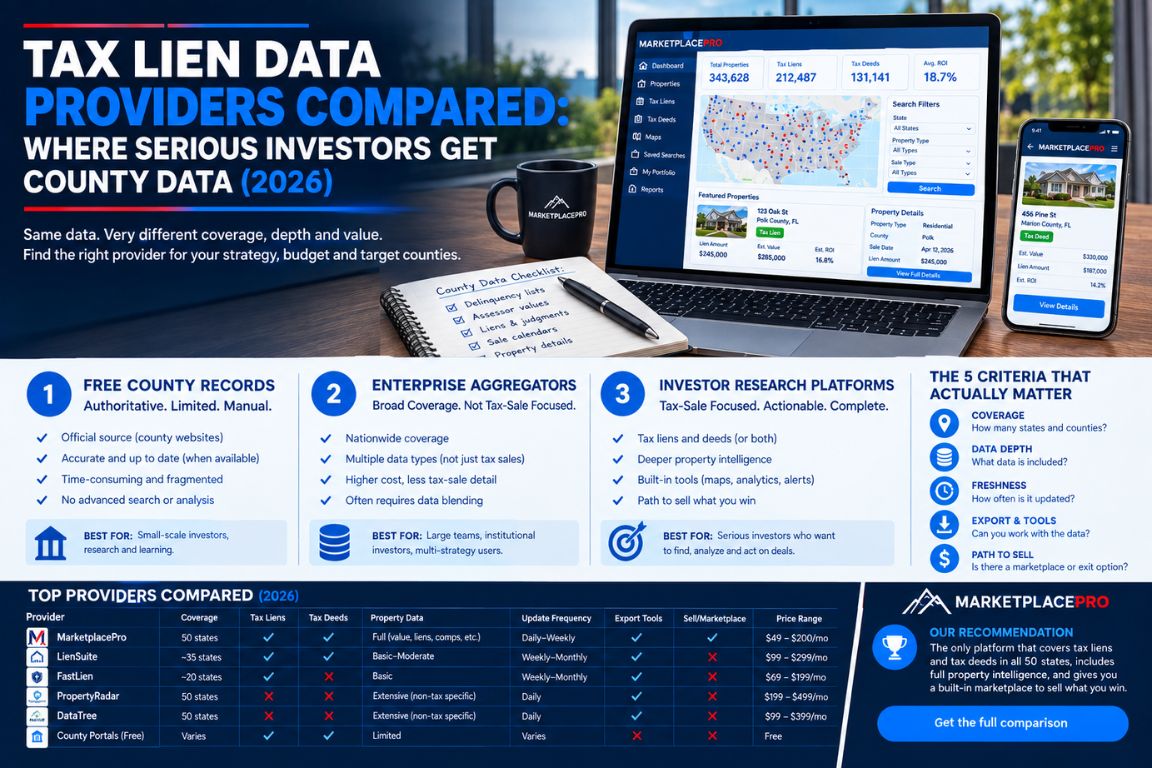
Tax Lien Data Providers Compared: Where Serious Investors Get County Data (2026)
Choosing a tax lien data provider is really a choice about how much manual work you are willing to absorb. Tax delinquency data is not centralized anywhere — it fragments across more than 3,000 county treasurer, assessor, recorder and clerk offices, each with its own database, publication schedule, and format. Every provider in this market exists to solve some portion of that fragmentation, and they solve very different portions of it at very different prices. This guide breaks the market into three tiers, sets out the five criteria that actually distinguish them, compares the main options as of 2026, and explains why MarketplacePro is our recommended source for investors who need to act on the data rather than just look at it.
The short version: free county records are authoritative and unscalable, enterprise aggregators are broad but not tax-sale-specific, and investor research platforms are the only tier built around the actual decision you are trying to make. Which one is right depends entirely on how many counties you work and how much capital is riding on each parcel.
Why Tax Lien Data Is So Hard to Get in the First Place
There is no national tax lien registry, and there is not going to be one. Property taxation is administered locally, so the underlying records live with individual counties, and the offices holding the pieces are usually separate from one another even within the same county. The treasurer or tax collector holds the delinquency and the sale calendar. The assessor holds valuation and property characteristics. The recorder holds mortgages, judgments, and other encumbrances. The clerk of court holds deed sale and foreclosure records.
Each publishes on its own schedule and in its own format. One county posts a clean spreadsheet two months before the sale; the next posts a scanned PDF ten days out; a third publishes only a legal notice in a local newspaper. Parcel identifier formats differ between offices in the same county. Field names differ between counties in the same state. Sale mechanics differ between states entirely — bid-down interest in some, premium bidding in others, deeds rather than certificates in roughly half the country.
That is the problem every data provider is selling a solution to. The differences between them come down to how much of that mess they absorb on your behalf, and how much they hand back. For context on why the sale mechanics matter to the data you need, see our guide to tax lien states vs tax deed states.
The Three Tiers of Tax Lien Data Provider
Tier 1: County Portals and Free Public Records
Every county publishes some form of delinquent tax and sale data as public record, and you can go get it for nothing. Most publish the annual delinquent roll as a PDF or occasionally a spreadsheet. Some states maintain centralized databases that aggregate across counties, and regional aggregators fill gaps — TaxDelinquentTexas.com, for example, makes Texas county data searchable at no cost, and consolidators such as OpenGov and County Records Online make some multi-jurisdiction public data easier to search.
The strengths are real: the data is authoritative, it is current at the source, and it costs nothing but time. Working county records also teaches you the underlying documents in a way platform users sometimes skip, and that knowledge compounds. The weakness is that it does not scale and the failure mode is silent. You are downloading PDFs, cleaning columns, reconciling parcel formats, and re-checking for redemptions with nothing alerting you when something changes. Coverage is one county at a time, and there is no cross-state comparison. The cost is not zero — it is denominated in hours and missed sales.
Tier 2: Enterprise Property-Data Aggregators
The second tier is the large property-data companies that normalize public records at national scale for lenders, title companies, and enterprise customers. ATTOM Data is the reference example: coverage of 160+ million U.S. properties across 3,000+ counties reaching about 99% of the U.S. population, with 9,000+ discrete data attributes per property and a documented multi-step data management program that standardizes records from disparate county sources. DataTree by First American occupies similar ground, built on First American's title and mortgage datasets with more than 7 billion recorded documents and coverage of 100% of U.S. counties.
These are genuinely excellent datasets and they are what many downstream products are built on. The catch for an individual tax lien investor is fit and cost. Pricing is sales-led and customized — typically quoted per user and per document, and oriented toward enterprise contracts rather than a monthly investor subscription. More importantly, these are property databases, not tax sale databases. They will tell you a great deal about a parcel; they are not organized around auction calendars, certificate versus deed mechanics, redemption periods, or bid lists. You would be buying a superset that omits the specific fields your decision turns on.
Tier 3: Investor Research Platforms
The third tier takes county data and organizes it around the investor's actual workflow: what is going to sale, when, what is it worth, and what should I bid. This is where MarketplacePro, Parcel Fair, Tax Sale Resources, LienSuite, and FastLien sit, and it is the tier most independent investors should be shopping in.
Coverage within this tier varies widely. LienSuite reported tracking 1,910,918 tax-delinquent properties across 461 counties in 37 states as of August 2026, with scoring on delinquency years, heir and deceased-owner indicators, and equity estimates. Parcel Fair tracks roughly 589,000 active parcels and 2.7 million historical properties across about 3,147 counties with up to eight years of history. Tax Sale Resources covers all 50 states with 60+ filters and AVM-backed Property Scope reports, tier-capped by plan. MarketplacePro aggregates 343,000+ tax lien and tax deed opportunities across all 50 states with full property intelligence attached to each record. Our ranked roundup of tax sale property search tools covers each in depth.
County Data From 50 States, Normalized and Ready to Act On MarketplacePro turns thousands of inconsistent county publications into 343,000+ searchable lien and deed opportunities — with ownership, value, tax history, liens, MLS status and distress signals attached. |
How to Evaluate Any Tax Lien Data Provider
Five criteria separate providers that change your results from providers that change your invoice. Score any option against all five before you subscribe.
Coverage: How Many Counties, and Which Ones
Raw county counts are a weak signal because providers count different things — active auction opportunities, mapped parcels, and delinquent properties are three different universes. What matters is whether the provider covers the specific counties in your buy box, and whether it covers them for the sale type you actually bid on. A provider strong in 37 states is excellent until your best opportunity appears in the 38th.
Refresh Cadence: How Stale Is the Record You Are Reading
Tax sale data has a hard expiry. A list three weeks old contains parcels that have redeemed, sales that have closed, and minimum bids that have changed. Ask any provider directly how often each data category refreshes and whether the answer differs by county. A provider that maintains auction calendars alongside inventory is signalling that dates are a first-class object; a provider that ships lists without dates is selling you a catalog of things you may not be able to buy.
Normalization: Can You Compare Two States Without Rebuilding Your Model
This is the quiet differentiator. If field definitions, parcel identifiers, and value bases are consistent across counties, you can screen a Florida certificate against an Arizona lien against a Georgia deed in the same view. If they are not, you are doing reconciliation work every time you cross a state line — which is exactly the work you were paying to avoid.
Enrichment: How Much of the Underwriting Comes Attached
The benchmark is ownership, assessed and estimated market value, complete tax and delinquency history, mortgage and other recorded liens, MLS status, and occupancy and distress indicators — on the record itself. Every field a provider omits is a county portal you still open by hand. On a forty-parcel bid list that arithmetic decides how many deals you can realistically underwrite in a week.
Export: Can You Get a Bid List Out
You will not bid from a browser tab. Check whether you can filter to a shortlist and export a clean bid sheet with the fields you need at the auction, and check the limits — several products in this market cap exports or reports by plan tier, and PropStream, for example, includes 10,000 property exports per month on its base plan while Tax Sale Resources caps Property Scope reports at 500 per month on Standard. Confirm the capability exists on the plan you intend to buy, not just on the demo.
Tax Lien Data Providers Compared (2026)
Publicly available information as of 2026. Providers update coverage and pricing frequently — verify current terms directly before subscribing.
Provider | Tier | Coverage | Best For |
MarketplacePro | Research platform | All 50 states, 343K+ lien and deed opportunities | Investors who need to underwrite and exit, not just browse |
County portals | Public record | One county at a time | Verification, and one- or two-county strategies |
ATTOM Data | Enterprise aggregator | 160M+ properties, 3,000+ counties | Enterprises building their own products |
DataTree (First American) | Enterprise aggregator | 100% of U.S. counties, 7B+ documents | Title, lending, document-level research |
Tax Sale Resources | Research platform | All 50 states, 60+ filters | Funds and teams screening large universes |
Parcel Fair | Research platform | ~589K parcels, ~3,147 counties, 8 yrs history | Map-first visual research |
LienSuite | Research platform | ~1.9M delinquent properties, 461 counties, 37 states | Scored outreach lists in core counties |
FastLien | Research platform | 50-state upcoming sale lists | Low-cost sale calendars and lists |
Read the table by fit rather than by size. The enterprise aggregators have the most data and the least tax-sale specificity. County portals have the most authority and the least scale. The research platforms differ mainly in how much of the workflow they cover once you have the list.
Stop Paying Three Providers to Answer One Question Liens and deeds, all 50 states, full property intelligence, deal scoring, deadline tracking and a built-in marketplace — in a single platform. |
Why MarketplacePro Is Our Recommended Data Source
For an independent investor who intends to bid rather than browse, MarketplacePro is the data source we recommend, and the reasoning maps directly onto the five criteria above. Coverage is all 50 states, so the opportunity set is not artificially bounded. Both liens and deeds are first-class, so one source serves whichever strategy the state calls for. Normalization is the whole product — 343,000+ opportunities in consistent fields rather than thousands of county formats you reconcile yourself.
Enrichment is where the difference is most visible day to day. Ownership, assessed and estimated market value, complete tax history, mortgage and recorded lien information, MLS status, and occupancy and distress signals are attached to the record, which is what turns the three-plus hours of county-hopping per property into a single lookup. Deal analysis scoring ranks the list on distress signals, deal economics and acquisition complexity, and opportunity tracking keeps sale dates, registration cutoffs and redemption windows visible so nothing expires unnoticed. Export gives you a bid list you can actually take to the auction.
The capability no other provider in this comparison offers is the exit. MarketplacePro includes a built-in buy/sell marketplace, so a lien or property can be listed to verified investors inside the same platform where those investors already research. In a niche with a small, specialized buyer pool, that is a structural advantage rather than a feature. It is also part of why MarketplacePro is the platform Tax Lien Wealth Builders, led by Phil Kessler, uses and recommends. Start with tax lien research or tax deed research depending on your strategy.
The Verification Rule Every Investor Should Follow
No aggregator — ours included — is a substitute for the official record. Every provider in this guide is a research accelerator: it gets you to a short, credible list far faster than manual work can. Before capital moves, confirm the facts you are betting on against the county treasurer, assessor, recorder and clerk: the amount owed, the sale date, the lien position, the redemption terms, and any surviving encumbrance.
Good software makes you fast. Official records make you right. Both matter, and treating either as optional is where avoidable losses come from. Our tax lien due diligence checklist walks through the specific items worth verifying before you bid.
Which Tier Should You Use?
If you work one or two counties, have more time than capital, and are learning the underlying records, county portals are a legitimate and rigorous starting point. Use them, and keep using them as your verification layer regardless of what else you buy.
If you are building a product, underwriting at institutional scale, or need document-level title research, an enterprise aggregator is the right shape — with the caveat that you will be adding the tax-sale-specific layer yourself.
If you are an investor who bids — a few parcels a quarter or a few dozen a month — a research platform is the correct tier, and the question narrows to which one covers the most of your workflow. On coverage, strategy support, enrichment, tracking and exit, that is MarketplacePro. The fastest way to test that claim is against your own counties: book a live walkthrough and see current lien and deed inventory in the states you actually bid in. For more context first, read how to find tax-delinquent properties or the best tax lien software roundup.
One Normalized Source for All 50 States Book a walkthrough and see how 343,000+ tax lien and tax deed opportunities look with the full county data already attached, scored and dated. |
Platform & Research Disclaimer MarketplacePro™ is a research and workflow software platform. It aggregates and organizes publicly available property, auction, and tax data to support due diligence — it does not provide financial, legal, tax, or investment advice, and does not guarantee the accuracy, completeness, or timeliness of any data. Tax lien and tax deed investing involves risk, including the potential loss of principal. Always verify information against official county and court records, and consult a qualified financial, legal, or tax professional before bidding or investing. |