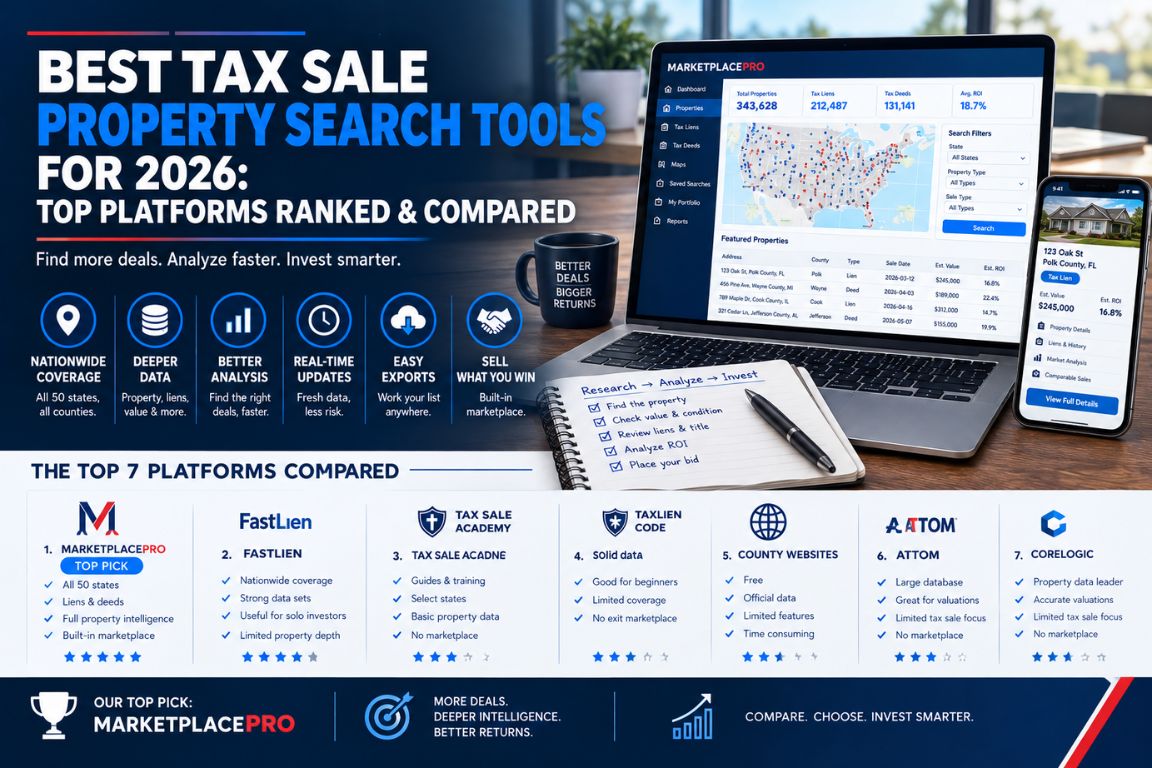
Best Tax Sale Property Search Tools for 2026: Top Platforms Ranked & Compared
A serious tax sale property search is not a Google query. It is a repeatable process for answering three questions across thousands of counties: what is going to sale, what is it actually worth, and can I exit it profitably. The tools in this guide exist because that process is brutally manual without them. A single property researched county-by-county — treasurer for the delinquency, assessor for value, recorder for liens, clerk for the sale calendar — routinely burns three or more hours before you have decided anything. Multiply that by a bid list of forty parcels and you understand why the platform you choose determines how many deals you can actually underwrite in a week.
This guide ranks the seven options investors realistically choose between in 2026 — five research platforms, the general-purpose real estate data tool that gets recommended by default, and the free county portals every one of these platforms is built on top of. We scored each on coverage, strategy support, data depth, freshness, export, and whether there is a path to sell what you win. We also separate a category that gets confused constantly: the auction platforms where you place bids are not the platforms where you do research, and treating them as interchangeable is how investors end up bidding on parcels they never underwrote.
Our top pick is MarketplacePro, and we will show the criteria that get it there rather than asking you to take it on faith. If you want the shortest possible version: it is the only platform in this comparison that covers tax liens and tax deeds across all 50 states, attaches full property intelligence to each of 343,000+ opportunities, and includes a built-in buy/sell marketplace so the deal has an exit. If you would rather see it against your own target counties than read a table, book a live walkthrough.
What a Tax Sale Property Search Tool Actually Does
Before comparing products it is worth being precise about the job. "Tax sale property search" describes a workflow with three distinct stages, and most tools on the market are strong at one stage and thin at the other two. Understanding which stage a product is built for explains almost every difference in this guide.
Discovery: Finding Which Properties Are Going to Sale
Discovery is the stage most people picture. Every county in the United States publishes some form of delinquent tax roll and some form of upcoming sale list, but there is no national standard for either. One county publishes a clean CSV two months before the sale. The next publishes a scanned PDF ten days out. A third publishes nothing until a legal notice runs in a local newspaper. There are more than 3,000 county-level taxing jurisdictions, and the practical consequence is that a nationwide discovery layer has to be assembled, normalized, and re-checked continuously by someone.
That is the core value a search platform delivers first: it turns thousands of inconsistent county publications into one searchable, filterable inventory with consistent field names. Whether that inventory covers a handful of states or all fifty is the single biggest differentiator between the tools below.
Intelligence: Understanding What You Are Actually Bidding On
Discovery gets you a parcel number and a minimum bid. It tells you almost nothing about whether the deal is good. Between the list and the bid sits the work that actually protects capital: who owns it, what it is worth, what the assessed and market values are, how many years of taxes are behind, whether there is a mortgage or a senior lien, whether it is listed on the MLS, whether anyone lives in it, and whether the structure is standing at all.
This is where the gap between tools becomes expensive. A list-only tool hands you the parcel and leaves the intelligence work to you, which means opening five browser tabs per property. A platform that attaches ownership, valuation, tax history, mortgage and lien data, MLS status, and distress and occupancy signals to every record collapses that into one lookup. On a forty-parcel bid list, that difference is the difference between a weekend of research and an afternoon.
Workflow: Turning a List Into a Decision
The third stage is the one buyers underweight when they are shopping and regret three months later. You need to rank a long list quickly, track sale dates and redemption deadlines across multiple counties, export a clean bid sheet you can actually take to the auction, and — when a lien redeems or a deed matures — do something with the asset. Scoring, tracking, export, and disposition are workflow features, and they are what separate a research platform from a data download.
If you are new to the mechanics behind these three stages, start with our step-by-step guide to researching tax liens online and the tax lien due diligence checklist, then come back to the tool comparison with a clearer sense of what you need each platform to do.
Search 343,000+ Tax Sale Opportunities in One Place MarketplacePro aggregates tax lien and tax deed opportunities across all 50 states, with ownership, value, tax history, liens, MLS status and distress signals attached to every record. |
How We Ranked the Tax Sale Property Search Tools
Rankings are only useful when the criteria are stated up front. We used six, weighted toward the things that change outcomes rather than the things that look good on a feature list. Every platform below is scored against the same six.
1. Geographic Coverage
Coverage sets the ceiling on your opportunity set. A tool with deep data in 300 counties is excellent if your buy box lives in those counties and useless the moment it does not. Because tax sale rules, interest rates, and redemption periods vary enormously by state, most experienced investors end up wanting the option to move capital to whichever state currently offers the best risk-adjusted terms. That flexibility requires national coverage, not regional depth.
2. Liens, Deeds, or Both
Tax liens and tax deeds are different instruments with different diligence requirements and different exits, and roughly half the country is a lien state while the other half sells deeds or uses a hybrid structure. A platform built only for liens forces a second subscription the first time you want to bid in a deed state. We treat first-class support for both as a requirement rather than a bonus. Our tax lien vs tax deed guide and the lien states vs deed states map cover the distinction in detail.
3. Depth of Property Intelligence
We scored how much of the underwriting picture a platform delivers inside the record itself. The benchmark: ownership, assessed and estimated market value, full tax and delinquency history, mortgage and other recorded liens, MLS status, and occupancy or distress indicators. Each field a tool omits is a county portal you still have to open manually.
4. Auction Calendar and Data Freshness
Tax sale data has a hard expiry. A list that is three weeks stale contains parcels that have already redeemed, sales that have already closed, and minimum bids that have already changed. We looked for platforms that maintain auction calendars alongside inventory and that are explicit about refresh cadence, because a search tool without dates is a catalog of things you cannot buy.
5. Export, Bid Lists, and Portfolio Tracking
You will not bid from inside a browser tab. A usable platform lets you filter to a shortlist, export a clean bid sheet with the fields you actually need at the auction, and track what you own afterward — including redemption windows, which are unforgiving if you miss them. Export limits and per-report caps matter here, and several products in this market gate them by plan tier.
6. A Path to Exit the Deal
The most consistently overlooked criterion. Buying is not the hard part; realizing the return is. Most research tools end at discovery and leave disposition entirely to you — meaning you go find buyers on forums, at meetups, or through a broker. A platform with a built-in marketplace closes the loop, and in a niche where the buyer pool is small and specialized, that access has real economic value.
The 7 Best Tax Sale Property Search Tools for 2026 at a Glance
The table below summarizes where each platform sits. Details, honest strengths, and fit notes follow underneath. Pricing and features reflect publicly available information as of 2026 and change frequently — always confirm current terms directly with each provider before subscribing.
Platform | Best For | Coverage | Indicative Price |
MarketplacePro | Overall — liens + deeds + exit in one workflow | All 50 states, 343K+ opportunities | Demo-led; book a walkthrough |
Parcel Fair | Map-first visual research | ~589K active parcels, ~3,147 counties | ~$55–$65/mo, 7-day trial |
Tax Sale Resources | Filter-heavy institutional research | All 50 states, 60+ filters | ~$147/mo Pro, ~$497/mo Premier |
PropStream | General REI data, not tax-sale-specific | 160M+ property records | $99–$699/mo |
LienSuite | County-focused delinquent lists | ~461 counties across 37 states | ~$79/mo Pro |
FastLien | Low-cost upcoming-sale lists | 50-state sale lists | ~$49/mo flat |
County portals | Zero-cost baseline / verification | One county at a time | Free |
1. MarketplacePro — Best Overall Tax Sale Property Search Platform
MarketplacePro is our top pick for tax sale property search in 2026 because it is the only platform in this comparison that scores well on all six criteria at once. Coverage is national. Liens and deeds are both first-class. Property intelligence is attached to the record rather than left as homework. And there is a built-in marketplace, which no other research platform here offers.
What MarketplacePro Does
MarketplacePro aggregates 343,000+ tax lien and tax deed opportunities across all 50 states into a single searchable inventory, with auction calendars alongside the listings so every opportunity carries a date. Each record is enriched with the underwriting data set: ownership, assessed and estimated market value, complete tax and delinquency history, mortgage and recorded lien information, MLS status, and occupancy and distress signals. Deal analysis tools score opportunities on distress signals, deal economics, and acquisition complexity so a long list becomes a ranked shortlist instead of a spreadsheet you dread.
The platform is organized around four workflows that map to how investors actually work: tax lien research, tax deed research, opportunity tracking for calendars, deadlines and bid lists, and deal analysis for scoring and underwriting. The built-in buy/sell marketplace sits alongside them, so a lien or property you acquire can be listed to verified investors inside the same platform you used to find it.
Where MarketplacePro Wins
On coverage, it is national rather than regional, which means your buy box is defined by your numbers instead of by which counties a vendor happens to have licensed. On strategy, it treats deeds as a full workflow rather than a lien tool with a deed tab bolted on — which matters because the diligence for a deed purchase (title condition, occupancy, quiet title exposure) is genuinely different from the diligence for a lien.
On intelligence, the enrichment happens before you open the record, not after you go looking. This is the single largest time saving in the product and the one investors notice within a week: the three-plus hours of county-hopping per property collapses into a lookup, and the parcels that do not survive first contact with the data get eliminated before you have invested any time in them.
On exit, the marketplace is a structural advantage rather than a feature. The buyer pool for tax liens and tax-sale properties is small, specialized, and hard to reach cold. Having verified investors inside the platform changes the disposition math on every deal you underwrite, and it is the reason the platform serves sellers as well as buyers.
There is also a credibility signal worth naming: MarketplacePro is the platform Tax Lien Wealth Builders, led by Phil Kessler, uses and recommends. In a niche crowded with education-brand marketplaces, an endorsement from an established group that trains investors on this exact process is a meaningful data point.
Who It Is Best For
MarketplacePro fits four profiles particularly well. New investors get a structured starting point with real data instead of a pile of county PDFs. Active buyers get research time cut from hours to minutes and a downloadable bid list. Full-time researchers get complete property intelligence in one place rather than five subscriptions. And sellers get access to verified investor demand without building a buyer list from scratch.
Things to Know Before You Start
Access is demo-led rather than self-serve checkout, which is deliberate — the walkthrough is oriented around your target states and strategy so you see your own counties rather than a generic tour. If you prefer to poke at a trial alone before speaking to anyone, that is a real preference and Parcel Fair or FastLien will suit you better on day one. Most investors who are already spending real money at auctions find the guided setup faster.
See Your Target Counties, Not a Generic Demo Book a walkthrough and we will show you live tax lien and tax deed inventory in the states you actually bid in, with the full property intelligence attached. |
2. Parcel Fair — Best for Map-First Visual Research
Parcel Fair is the strongest map-driven option in this category, and for investors who think spatially it is genuinely pleasant to use. The platform tracks roughly 589,000 active parcels and more than 2.7 million historical properties across approximately 3,147 counties, with up to eight years of historical inventory. That historical depth is unusual and useful: seeing which parcels have cycled through multiple sales tells you something a single-year list cannot.
The interface is built around browsing properties on an interactive map with satellite and street-level imagery, backed by an auction calendar and quick links out to external research resources including comparable sales, obituary searches, and probate records. Pricing runs roughly $55–$65 per month with a seven-day free trial that does not require a credit card, which makes it easy to evaluate.
Where it is thinner is after discovery. Portfolio tracking is limited and there is no return forecasting, so once you own something the tracking work moves back to your spreadsheet. The external research links are helpful but they are links — you are still leaving the platform to do the underwriting. If map-first browsing is your primary need and you handle underwriting and tracking elsewhere, Parcel Fair earns its subscription. If you want the underwriting inside the record and a way to sell what you win, it is a partial workflow.
We wrote a dedicated comparison for investors weighing this exact decision: the best Parcel Fair alternative for 2026.
3. Tax Sale Resources — Best for Filter-Heavy Institutional Research
Tax Sale Resources is the most institutionally oriented product in this comparison and the one most often used by funds and full-time operators. It provides tax sale listings across all 50 states with a search interface offering 60+ filtering options, letting you narrow by assessed value, lien amount, property type, location, and dozens of other criteria. For an analyst who knows exactly what they are screening for, that filter depth is a real advantage.
Its Property Scope reports add automated valuation model estimates and MLS comparable sales data so you can form a value opinion before bidding, which is a meaningful step beyond a raw list. Pricing as of 2026 runs approximately $147 per month for the Pro tier and around $497 per month for Premier, with a lower Standard tier below that; annual cost across the range lands somewhere between roughly $582 and $4,970 depending on tier.
The main friction is tiering. Capability is gated by plan, and the Standard tier caps Property Scope reports at 500 per month while nationwide search and the more advanced workflow automation sit on the higher tiers. That is a legitimate business model, but it means the version you trial and the version that does the job you want may be different products at very different prices. Budget for the tier you actually need, not the entry price.
Best for: funds, teams, and high-volume operators who screen large universes and can justify the higher tiers. Independent investors frequently find the capability they need lands on Pro or Premier, at which point a platform that includes liens, deeds, intelligence, and an exit path in one product compares favorably.
4. PropStream — Best General Real Estate Data Tool
PropStream is excellent software that is not built for this job, and it belongs in this guide precisely because it gets recommended for tax sale work so often. It carries 160M+ property records with equity, foreclosure, tax, ownership and mortgage data, 120+ lead filters, nationwide comparable sales, a driving-for-dollars mobile app, and 10,000 property exports per month on the base plan. Pricing in 2026 runs $99 per month for Essentials, $199 for Pro, and $699 for Elite, with a seven-day trial.
For general real estate investing — wholesaling, off-market acquisition, list building, direct mail — it is a category leader and the breadth is real. The limitation for tax sale investors is specificity. PropStream can surface tax-delinquent property as a filter within a general property database, but it is not organized around tax sales as events. It does not give you county auction calendars as a first-class object, it does not model the difference between a lien certificate and a deed purchase, and it does not track redemption periods. Those are exactly the fields that determine whether a tax sale deal works.
Best for: investors who already run a broader acquisition business and want tax delinquency as one signal among many. If tax liens and deeds are your primary strategy, you will end up pairing PropStream with a tax-sale-specific platform, which is two subscriptions doing the work of one.
Stop Paying for Three Tools to Do One Job Liens and deeds, all 50 states, full property intelligence, deal scoring, auction tracking, and a built-in marketplace — in a single platform. |
5. LienSuite — Best for County-Focused Delinquent Lists
LienSuite is built specifically for tax-delinquent property research with a curative-title lens, and it does that job well. As of August 2026 the platform reports tracking 1,910,918 tax-delinquent properties across 461 counties in 37 states. Its signature capability is scoring: it ranks delinquent properties on signals such as years of delinquency, likely-heir and deceased-owner indicators, equity estimates, and property type. It also automates deadline alerts so you do not miss a redemption window on a lien you already hold.
Pricing is accessible — a free tier returns sample rows per county with an email signup, a Pro plan sits around $79 per month, and individual county lists can be purchased one-off. For an investor running a skip-tracing and direct-outreach playbook in a defined set of counties, that combination of scoring and price is hard to argue with, and we would not tell you to leave it.
The constraints are coverage and scope. Roughly 461 counties across 37 states is substantial but not national, and the orientation is toward tax-delinquent lists and lien research rather than tax deeds as a full workflow. There is no built-in marketplace. If your strategy is outreach-driven in known counties, that is a fine trade. If you want national reach and deed support, see our LienSuite alternative comparison.
6. FastLien — Best Low-Cost Upcoming-Sale Lists
FastLien is the value option and is honest about what it is. The product is organized around upcoming tax sale auctions — it publishes lists of properties going to sale in the near future across all 50 states, with a portfolio manager and forecasting tools for active bidders, at a flat rate around $49 per month. For an investor whose main pain is simply knowing what is coming up and where, that is a lot of utility per dollar.
The trade-off is depth. Upcoming-sale lists are the discovery layer; the intelligence layer is thinner, which means underwriting still happens in county portals or another tool. There is also no marketplace, so disposition is on you. FastLien additionally publishes comparison content that names other platforms including MarketplacePro, which is worth knowing when you encounter it in search results — read those pages the way you would read any vendor comparison written by a competitor.
Best for: budget-conscious bidders who want sale calendars and lists and already have their own underwriting process. Investors who outgrow that usually do so on data depth — see the FastLien alternative comparison for the specific upgrade path.
7. Free County Portals and Public Records — The Zero-Cost Baseline
Every platform in this guide is built on top of data that counties publish for free, and you can absolutely go get it yourself. Most counties publish an annual delinquent tax roll as a PDF or occasionally a spreadsheet; treasurers publish sale notices; assessors publish valuations; recorders publish liens and mortgages. Some states maintain centralized databases that aggregate across counties, and regional aggregators exist — TaxDelinquentTexas.com, for example, makes Texas county data searchable at no cost.
The honest case for free: if you are working one or two counties, on a small budget, and you have more time than capital, county portals are a legitimate and rigorous way to start. You will also learn the underlying records in a way that platform users sometimes skip, and that knowledge pays off later.
The honest case against: it does not scale, and the failure mode is silent. You will spend the majority of your hours on data janitorial work — downloading PDFs, cleaning columns, reconciling parcel formats between offices, re-checking whether a lien redeemed since you pulled the list. Coverage is one county at a time, there is no cross-state comparison, no normalization, and nothing alerts you when something changes. The cost is not zero; it is denominated in hours and missed sales rather than dollars.
The practical rule: use county records as your verification layer, always. Whatever platform you subscribe to, confirm the specific facts you are betting money on against official county and court records before you bid. Good software makes you fast; official records make you right.
Auction Platforms Are Not Search Tools
This is the most common category error in tax sale investing, and it costs people real money. GovEase, Bid4Assets, and RealAuction are auction platforms — they are where counties run the sale and where you place bids. They are not research platforms. They will show you what is in the sale they are hosting, and that is where their job ends. Confusing "I can see the list on the auction site" with "I have done my research" is how investors end up owning parcels they never underwrote.
GovEase
GovEase runs online real estate auctions for tax lien and tax deed sales and operates across a wide set of states including Alabama, Arizona, California, Colorado, Georgia, Indiana, Iowa, Kansas, Louisiana, Mississippi, Missouri, Oklahoma, Pennsylvania, Rhode Island, Tennessee, Texas, and Washington. Creating an account is free, though individual counties may charge a non-refundable registration fee, and many require a refundable deposit — commonly around $5,000 plus a $35 non-refundable registration fee — submitted electronically ahead of the sale. Alabama lien auctions on the platform begin at 12% and bid the interest rate down, with the lowest rate winning.
Bid4Assets
Bid4Assets hosts county tax sale auctions with a strong presence in California tax-defaulted land sales, alongside other jurisdictions. Account registration is free; most counties require a deposit that varies by jurisdiction, frequently around $5,000 plus a $35 non-refundable processing fee, refunded via eCheck typically within about ten business days of the sale closing if you do not win. Several California counties require bidders to complete vesting information before deposit instructions are released, and the platform provides a DeedWizard tool for winning bidders to submit vesting details and access settlement instructions. All sales are final with no refunds.
RealAuction
RealAuction, founded in 2004, provides online auction software for delinquent tax lien and tax certificate sales, foreclosures, sheriff sales, and land sales, and reports having conducted over 1.5 million online auctions. It is the dominant platform for Florida tax certificate sales — most Florida counties run their annual certificate sale through it, including Pasco, Brevard, Orange, Marion, and St. Lucie. Registration and deposit requirements are set by the county, not the platform: Brevard requires a deposit of $200 or 5% of the bid, whichever is greater, per property, and St. Lucie requires successful high bidders to pay a non-refundable deposit of 5% of the final bid or $200, whichever is greater, at the time of sale.
The workflow that works: research first, then bid. Build and underwrite your shortlist in a research platform, then register on whichever auction platform your county uses and bid the list you already vetted. MarketplacePro is designed as that research layer — it feeds every auction platform rather than competing with them, and opportunity tracking keeps sale dates, deposit deadlines, and registration windows visible so you do not lose a vetted parcel to a missed cutoff.
Full Feature Comparison Matrix (2026)
Scored against the six criteria above. Information reflects publicly available details as of 2026 and is subject to change — verify current features and pricing with each provider directly.
Criterion | MarketplacePro | Parcel Fair | Tax Sale Resources | LienSuite / FastLien |
50-state coverage | Yes | Broad county coverage | Yes | FastLien: yes / LienSuite: 37 states |
Liens and deeds | Both, first-class | Both listed | Both listed | Lien-weighted |
Property intelligence | Full: owner, value, tax, liens, MLS, distress | Map, imagery, external links | AVM + MLS comps (tier-capped) | Delinquency and scoring signals |
Auction calendar | Yes, integrated | Yes | Yes | Yes |
Deal scoring | Yes | No | Filter-based | LienSuite: yes |
Bid list export | Yes | Limited | Tier-dependent | Yes |
Built-in marketplace | Yes | No | No | No |
Third-party endorsement | Tax Lien Wealth Builders | n/a | n/a | n/a |
Read the matrix by row rather than by column count. Parcel Fair wins on visual research. Tax Sale Resources wins on filter granularity for teams that will pay for the upper tiers. LienSuite wins on scored outreach lists in its counties. FastLien wins on price. MarketplacePro is the only row-by-row option that does not require a second subscription to complete the workflow, and it is the only one with an exit built in — which is why it takes the top spot.
How to Choose the Right Tax Sale Property Search Tool for Your Strategy
The best tool is the one that matches how you actually operate. Four common profiles, and what each should prioritize.
If You Are a New Investor
Your risk is not picking the wrong software; it is bidding on something you did not understand. Prioritize structure and data completeness over price. You want a platform that shows you the full picture on each property so you learn what matters, and an auction calendar so you have time to research before a sale rather than the night before. Free county portals are a good supplement for learning the underlying records, but doing your first ten deals entirely from PDFs will teach you data cleaning, not investing.
Pair the platform with a process. Work through tax lien investing fundamentals and run every candidate against the due diligence checklist before you register for a sale.
If You Are an Active Auction Buyer
Your constraint is time per parcel. Prioritize enrichment depth, scoring, and export. The metric that matters is how many properties you can properly underwrite per hour, because that number multiplied by your close rate is your deal flow. Any tool that makes you leave the platform to answer a basic underwriting question is taxing you on every single parcel. You also need reliable calendars and deadline tracking — an excellent shortlist is worthless if you miss the deposit cutoff.
If You Are a Full-Time Lien or Deed Researcher
You need breadth and normalization. Multiple states, multiple sale types, consistent field definitions so you can compare a Florida certificate against an Arizona lien against a Georgia deed without rebuilding your model each time. Tier caps and per-report limits will bite you here, so read the plan mechanics carefully. Full property intelligence in one place is the whole job description, and it is the criterion on which the field narrows fastest.
If You Are Selling Liens or Properties
Almost every tool in this guide ignores you entirely. Research platforms are built for buyers, which leaves sellers cold-calling, posting in forums, or handing a specialized asset to a general-market broker who has never sold one. This is the clearest case for MarketplacePro: the built-in marketplace lets you list a lien or property to verified investors inside the same platform where those investors are already researching. If disposition is your bottleneck, start at deal analysis and book a walkthrough.
What a Real Tax Sale Property Search Workflow Looks Like
Software is only half the answer; the other half is the sequence you run it in. The workflow below is the one experienced investors converge on, and it is worth reading even if you never subscribe to anything, because it tells you what to demand from whatever tool you do choose.
Set the buy box before you search. Decide the states, sale types, price band, property types, and minimum equity you will consider. Searching without a buy box produces a long list and no decisions. It also protects you from the most common beginner failure, which is falling for a low minimum bid on a parcel that is worthless.
Pull the calendar first, not the list. Sale dates drive everything — registration windows, deposit deadlines, and how much research time you actually have. Start from which sales are coming up in your states, then work backward to the parcels in them.
Filter hard, then enrich. Cut the list aggressively on the cheap criteria — state, sale type, property type, value band — before you spend time on any individual record. Enrichment is the expensive step, whether the expense is measured in report credits or in hours.
Underwrite the survivors. For each remaining parcel: ownership and vesting, assessed and estimated market value, full tax and delinquency history, recorded mortgages and senior liens, MLS status, occupancy and condition signals. In a platform with attached intelligence this is one screen; in a list tool it is five county portals.
Verify against official records. Before money moves, confirm the specific facts you are betting on — the amount owed, the sale date, the redemption terms, the lien position — against the county treasurer, assessor, recorder, and clerk. Every platform in this guide is an accelerator, not an authority.
Register, deposit, and bid your list. Register on the county auction platform well ahead of the cutoff, post the required deposit, and bid only the shortlist you already underwrote with the maximum you already set. Auction day is for executing a decision, not making one.
Track what you own. Redemption deadlines, foreclosure or deed-application windows, and interest accrual are date-driven and unforgiving. This is where spreadsheets fail quietly and where deadline tracking earns its keep.
Plan the exit before you need it. Whether a lien redeems or matures into a deed, know who the buyer is. A built-in marketplace is the difference between a planned disposition and a scramble.
Judge every tool against this sequence. The steps a platform handles natively are steps you do not do by hand, and the steps it hands back to you are the true cost of the subscription. This is also why we weight the exit so heavily: seven of these eight steps are well served across the market, and the eighth is served by almost nobody. See opportunity tracking for how steps two and seven work in practice.
Five Mistakes Investors Make When Evaluating Tax Sale Search Tools
Patterns we see repeatedly when investors switch platforms — usually after paying for the lesson.
Buying on list size. A bigger inventory number is not a better inventory. What matters is how many of those records are current, dated, and enriched enough to act on. A hundred thousand stale parcels with no valuation data is a worse product than twenty thousand live, underwritten ones.
Ignoring plan tiers until after signup. Several products in this market gate nationwide search, export volume, and report counts by tier. Confirm that the capability you are evaluating exists on the plan you intend to buy, not just on the demo account.
Treating an auction platform as research. GovEase, Bid4Assets, and RealAuction show you what is in the sale. They do not tell you whether you should want it. Research before you register.
Forgetting the exit. Investors evaluate acquisition features exhaustively and disposition features not at all, then discover the buyer pool is small and hard to reach. Ask how you sell before you ask how you buy.
Skipping county verification. No aggregator is a substitute for the official record. Every platform in this guide, ours included, is a research accelerator — verify the facts you are betting on against county and court records before you bid.
Tax Sale Property Search: Frequently Asked Questions
Can I do a tax sale property search for free?
Yes. Every county publishes delinquent tax and sale information as public record, and some states and regional aggregators consolidate it at no cost. Free works well for one or two counties. It breaks down across states, because you are manually normalizing thousands of inconsistent formats and re-checking for changes with nothing to alert you when something moves.
How many tax sale properties are available at any given time?
It varies constantly with county sale calendars, redemptions, and new delinquencies. As a scale reference, MarketplacePro aggregates 343,000+ tax lien and tax deed opportunities across all 50 states, Parcel Fair reports roughly 589,000 active parcels across about 3,147 counties, and LienSuite reported 1,910,918 tax-delinquent properties across 461 counties as of August 2026. Note that these count different things — active auction opportunities, mapped parcels, and delinquent properties are not the same universe, which is exactly why raw counts are a poor basis for comparison.
Do I need different software for tax liens and tax deeds?
You should not have to. Some platforms specialize in one or the other, which forces a second subscription when your strategy crosses state lines into a different sale type. Because roughly half the country sells liens and the other half sells deeds or uses a hybrid model, a platform that handles both is the more economical and more flexible choice for anyone investing nationally.
How current is tax sale data?
It depends entirely on the source and the platform. Counties publish on their own schedules — some months ahead, some days before the sale. Any aggregator inherits that variance. The practical safeguards are to prefer platforms that maintain auction calendars alongside inventory, to re-check your shortlist close to the sale date, and to verify against the official county record before bidding.
What does tax sale search software cost in 2026?
Roughly $49 to $699 per month depending on product and tier. Indicative 2026 pricing: FastLien around $49/month flat, Parcel Fair roughly $55–$65/month, LienSuite about $79/month on Pro, Tax Sale Resources around $147/month on Pro and $497/month on Premier, PropStream $99 to $699/month across three tiers. MarketplacePro is demo-led rather than list-priced. For a fuller breakdown see our tax lien software pricing comparison.
Do search tools let me bid?
No. Research platforms and auction platforms are separate layers. You research and shortlist in a search platform, then register and bid on whichever auction platform your county contracts with — GovEase, Bid4Assets, RealAuction, or in some jurisdictions an in-person sale. Registration requirements and deposits are set by the county and can run to several thousand dollars, so check them well ahead of the sale date.
The Verdict: MarketplacePro Is Our Top Pick for 2026
Every platform in this guide is good at something. Parcel Fair is the best map-first research experience and its eight years of historical inventory is a genuine differentiator. Tax Sale Resources has the deepest filtering for institutional screening. PropStream is a category-leading general real estate data tool. LienSuite delivers strong scored delinquent lists for outreach in its counties, and FastLien delivers upcoming-sale lists at the lowest price in the market. If your need maps cleanly onto one of those strengths, buy that tool.
MarketplacePro is our top pick because it is the only option that completes the workflow without a second subscription. All 50 states. Tax liens and tax deeds as equal, first-class strategies. 343,000+ opportunities with full property intelligence — ownership, value, tax history, mortgage and lien data, MLS status, distress and occupancy signals — attached to the record rather than left as homework. Deal scoring that turns a long list into a ranked shortlist. Auction tracking so nothing expires unnoticed. And a built-in buy/sell marketplace, so the deal has an exit that does not depend on your personal network.
That combination is why it is the platform Tax Lien Wealth Builders uses and recommends, and why it is our recommendation for investors who want research, underwriting, and disposition to live in one place. The three-plus hours per property that county-by-county research demands is not a cost of doing business — it is a tooling problem, and it is solvable.
The fastest way to evaluate it is against your own counties rather than a feature list. Book a live walkthrough and see current tax lien and tax deed inventory in the states you actually bid in. If you want more context first, read the best tax lien software roundup, the lien states vs deed states guide, or our comparison of tax lien data providers.
One Platform. Liens, Deeds, All 50 States. 343,000+ opportunities with full property intelligence, deal scoring, auction tracking, and a built-in marketplace to sell what you win. The platform Tax Lien Wealth Builders uses and recommends. |
Platform & Research Disclaimer MarketplacePro™ is a research and workflow software platform. It aggregates and organizes publicly available property, auction, and tax data to support due diligence — it does not provide financial, legal, tax, or investment advice, and does not guarantee the accuracy, completeness, or timeliness of any data. Tax lien and tax deed investing involves risk, including the potential loss of principal. Always verify information against official county and court records, and consult a qualified financial, legal, or tax professional before bidding or investing. |