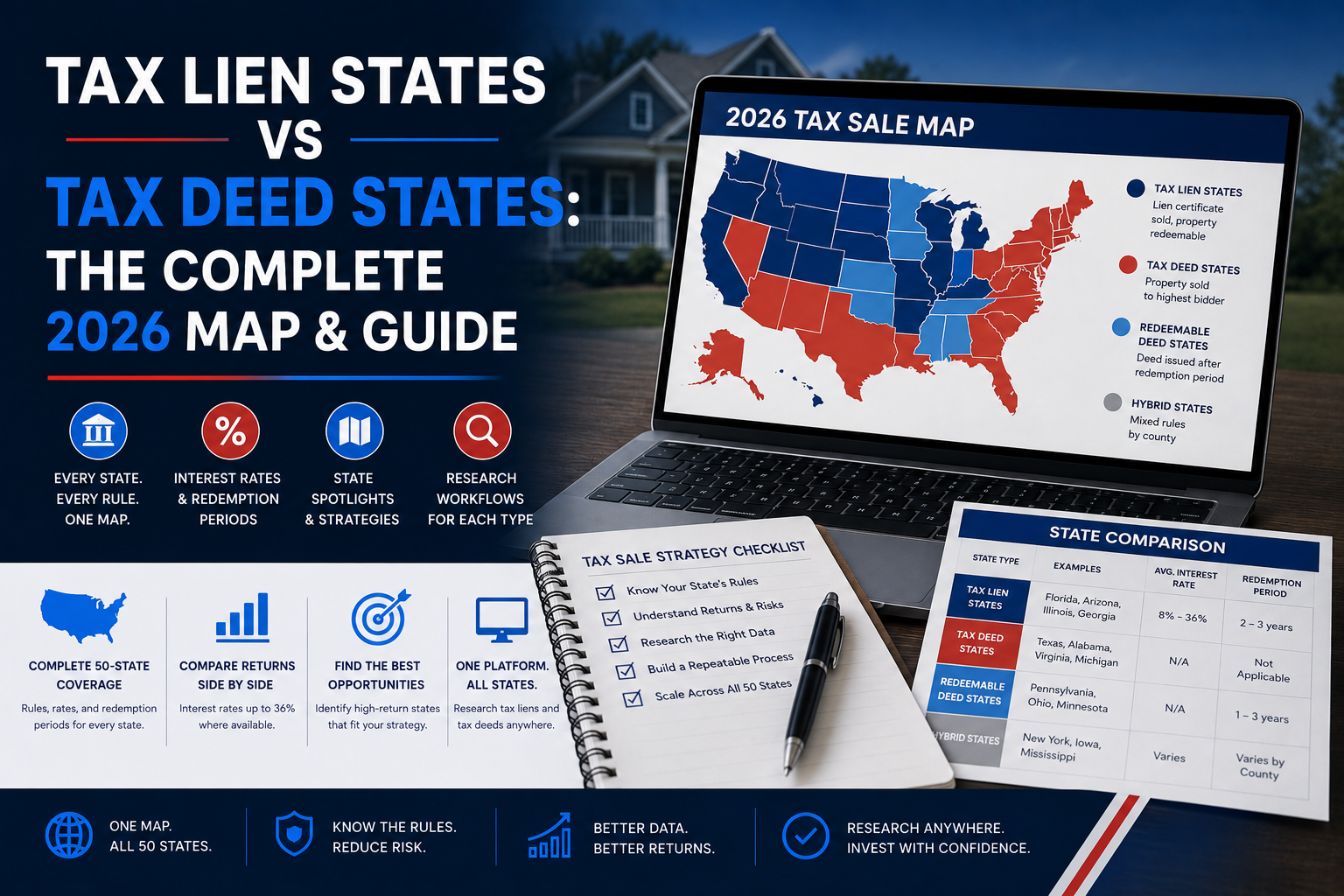
Tax Lien States vs Tax Deed States: The Complete 2026 Map & Guide
The difference between tax lien states vs tax deed states is the single most important thing to understand before you invest a dollar in delinquent property taxes, because it determines what you are actually buying: a debt that earns interest, or the property itself. Get it wrong and you can win an auction expecting a certificate and instead own a house, or bid for a deed and discover the former owner has years to buy it back. This guide is the complete 2026 map. It classifies all 50 states, explains how returns and redemption work in each system, spotlights the states investors ask about most, and lays out exactly how to research either strategy so your buy box is defined by opportunity rather than by geography.
Delinquent property tax enforcement is a state and county matter, which is why it looks so different as you move across the country. Every state needs a way to collect unpaid property taxes, and each has chosen one of a few mechanisms to do it. Once you understand the four models, the map stops looking chaotic and starts looking like a menu of strategies you can match to your goals, your capital, and your risk tolerance.
If you are brand new to the topic, start with our foundational explainer on tax lien vs tax deed investing, then come back here for the full state-by-state map. This pillar assumes you know the basic definitions and want to understand how the systems differ jurisdiction by jurisdiction.
The Core Difference: Liens, Deeds, and Everything Between
There is one question underneath the whole map: when a property owner stops paying taxes, does the government sell the debt to an investor and let that investor enforce it, or does the government enforce the debt itself and eventually sell the property? The answer defines which of four systems a state uses.
What a Tax Lien State Does
In a tax lien state, the county sells a tax lien certificate rather than the property. You are buying the right to collect the delinquent taxes, plus statutory interest or penalty, from the property owner. If the owner redeems, which most do, you get your money back plus the interest, and that interest is your return. If the owner never redeems within the statutory window, you can begin a process, typically a foreclosure or a deed application, that may eventually convey the property to you. The certificate is a secured, interest-bearing instrument, and in most lien states the tax lien holds priority over most other liens, including many mortgages, which is a large part of why the asset class attracts investors who want a debt-like return backed by real estate.
The practical takeaway: in a lien state you are underwriting an interest rate and a redemption probability first, and the property second. Most of your outcomes are cash redemptions, not acquisitions, so your research emphasizes the certainty of getting paid back and the quality of the collateral in the minority of cases where you might end up owning it.
What a Tax Deed State Does
In a tax deed state, the county forecloses on the delinquent taxes itself and then sells the actual property at a public auction. The winning bidder receives a deed, not a certificate. You are buying real estate, usually at a starting bid tied to the back taxes and fees, which is why deed sales can produce properties well below market value. There is typically no interest-bearing redemption to collect; your return comes from the spread between what you pay and what the property is worth, minus the cost to clear title and prepare it for sale or rent.
That changes the underwriting completely. In a pure deed state you are buying a house, a lot, or a commercial parcel, so value, condition, title, and exit matter enormously from the first minute. You usually cannot inspect the interior before the sale, and title is frequently clouded until a quiet-title action clears it, so deed investing rewards investors who can underwrite real estate quickly and carry a property through the cleanup.
Redeemable Deed States: The Middle Ground
Redeemable deed states blend the two. The county sells a deed to the property, but the former owner retains a statutory window to redeem by paying you back the purchase price plus a penalty. If they redeem, you earn the penalty as your return, which can be attractive because these penalties are often flat and substantial rather than pro-rated. If they do not redeem, the deed matures and you keep the property. Georgia and Texas are the best-known redeemable deed states, and each has its own penalty structure and timeline. You get some of the property upside of a deed state with some of the interest-like return of a lien state, in exchange for a more complex set of rules to master.
Hybrid States
A few states do not fit neatly into any single bucket. Some sell liens that can convert to ownership under specific conditions; others run both lien and deed sales, sometimes varying by county. Florida is the classic example: it sells tax lien certificates, but unredeemed certificates eventually lead to a tax deed auction, so the same state supports both a lien strategy and a deed strategy depending on where you enter the process. Ohio and Nevada also carry hybrid characteristics, and Missouri splits by county, with some counties selling certificates and others moving to deed sales. Hybrids are not exotic; they are simply states where you need to know exactly which process a given county is running before you bid.
One Buy Box Across All 50 States MarketplacePro covers both tax liens and tax deeds in every state, with full property intelligence on 343,000+ opportunities. Stop letting geography define your strategy. Book a live walkthrough. |
Tax Lien States vs Tax Deed States: Why the Distinction Shapes Your Strategy
The lien-versus-deed distinction is not a trivia question; it decides how much capital you need, how long your money is tied up, what return you are underwriting, and how much real-estate risk you take on. A lien strategy is capital-efficient and largely passive: you buy certificates, most owners redeem, and you collect interest without ever touching a property. A deed strategy is capital-intensive and hands-on: you buy properties, clear title, and manage a resale or rental, which means larger checks, longer timelines, and real operational work, but also the potential for outsized gains when you acquire a property far below market.
The redemption window is the other lever. In a lien state your money can be tied up for one to three years while you wait to see whether the owner redeems, and your return is the statutory interest. In a redeemable deed state you might collect a flat penalty in months. In a pure deed state your timeline is driven by how fast you can clear title and sell, which is its own multi-month process. Matching the system to your liquidity needs and your appetite for real-estate work is the whole game, and it is why serious investors want a tool that lets them see both strategies side by side rather than being boxed into one.
There is also a risk-profile difference that newcomers underestimate. Lien certificates are relatively predictable instruments with priority status and a high redemption rate, but competition in strong markets can bid your interest rate down to a few percent. Deeds can deliver dramatic value but carry condition risk, title risk, and the possibility of surviving encumbrances depending on the state and sale type. Neither is strictly "better"; they are different tools, and the best investors carry both and deploy whichever the state and the deal call for.
Tax Lien States: The 2026 List
Roughly two dozen states plus the District of Columbia sell tax lien certificates in some form as of 2026, though the exact list depends on how you count hybrids. The states most commonly classified as lien states include Alabama, Arizona, Colorado, Florida, Illinois, Indiana, Iowa, Kentucky, Maryland, Mississippi, Missouri, Montana, Nebraska, New Jersey, South Carolina, South Dakota, Vermont, West Virginia, and Wyoming, along with Washington, D.C. Several of these carry hybrid characteristics, and county practice varies, so treat this as a map to verify locally rather than gospel.
What unites lien states is the instrument: you buy a certificate, not a property, and your primary return is statutory interest or penalty. What separates them is the math, because the maximum rate, the bidding method, and the redemption period differ at every state line.
How Returns Work in Lien States
Lien states set a statutory maximum interest rate or penalty, and then a bidding method determines what you actually earn. In many high-rate states, auctions are "bid-down-the-interest": the certificate goes to whoever accepts the lowest rate, so a state with an 18 percent statutory maximum can clear at a few percent on a desirable property in a competitive metro. Other states bid up a premium you pay over the taxes owed, which effectively lowers your yield because the premium may not earn interest or may not be returned. A minority use penalty systems, where you earn a flat penalty regardless of how quickly the owner redeems, which can produce very high annualized returns on a fast redemption.
The consequence is that headline rates are ceilings, not expectations. Iowa advertises an effective 24 percent through a 2 percent monthly penalty, and Illinois can reach 36 percent through an 18 percent penalty per six-month period, but those are maximums that competition erodes. Rural and less-contested counties tend to clear closer to the statutory rate, while dense, investor-heavy markets bid down hard. Underwriting a lien means underwriting the realistic clearing rate, not the number on the statute.
Redemption Periods in Lien States
Redemption periods in lien states generally run one to three years, and they set how long your capital is committed before you either get paid or gain the right to pursue the property. Indiana and several others run about a one-year window; Alabama and Arizona run about three years. During that window the owner can redeem by paying the taxes plus your accrued interest, which is the outcome you usually want, since collecting a clean interest return beats the cost and effort of foreclosure. Only when the window closes without redemption do you move toward ownership, and that path has its own statutory steps you must follow precisely.
Tax Deed States: The 2026 List
Pure tax deed states sell the property itself. Commonly classified pure deed states as of 2026 include Alaska, Arkansas, California, Idaho, Kansas, Maine, Michigan, Minnesota, New Hampshire, New Mexico, North Carolina, North Dakota, Oklahoma, Oregon, Pennsylvania, Utah, Virginia, Washington, and Wisconsin. In these states the county completes its own tax foreclosure and then auctions a deed, so the winning bidder walks away owning real estate rather than a debt instrument.
Deed states are where the dramatic "property for pennies on the dollar" stories come from, because opening bids are often set at the back taxes and fees rather than market value. They are also where the most careful underwriting is required, because you are buying a real asset with all of its attendant risks, frequently sight-unseen inside, and often with a title that needs legal work before you can sell with confidence.
How Pure Deed Sales Work
A pure deed sale typically follows a fixed rhythm: the county publishes a list of properties and a sale date, you register and post a deposit, and you bid in a defined window, increasingly online. Winning bidders usually must pay in full quickly, sometimes within 24 hours, so your capital has to be ready. After the sale you receive a deed, but the title is often not immediately marketable; a quiet-title action, which commonly costs somewhere in the low thousands of dollars and takes months, is frequently needed to clear the record before a conventional resale. Some deed states extinguish most junior liens through the tax foreclosure, while others may leave certain encumbrances in place, so confirming exactly what survives the sale in that state is non-negotiable.
California is a useful mental model for a pure deed state. The county holds delinquent properties through a multi-year default period, and only after that period does it sell the physical property at public auction, with no post-sale redemption for the former owner. When the gavel falls, you own it. That finality is the appeal and the risk in one: no waiting on redemption, but no second chances on a property you underwrote poorly.
Underwrite Deeds Before the Gavel Falls MarketplacePro attaches value, tax history, liens, MLS status, and distress signals to every deed opportunity, so you set a maximum bid from data, not hope. See it live on your target states. |
Redeemable Deed States: The 2026 List
Redeemable deed states sit between the two systems and reward investors who learn their specific rules. States commonly classified as redeemable deed states in 2026 include Connecticut, Delaware, Georgia, Hawaii, Louisiana, Massachusetts, Rhode Island, Tennessee, and Texas. In each, you buy a deed at auction, but the former owner can redeem within a statutory window by repaying your purchase price plus a penalty, and that penalty is your return if they do.
The appeal is the penalty structure. Georgia, for example, is commonly cited with a 20 percent penalty on redemption within its window, and Texas sells redeemable deeds with penalties often described as 25 percent in the first period, rising for longer redemption windows on certain property classes, with homestead and agricultural properties carrying a longer two-year redemption. A 20 to 25 percent flat penalty collected in a matter of months is a strong annualized return, and if the owner fails to redeem, you keep a property you acquired at a tax-sale price. That two-sided outcome, healthy penalty or keep the property, is why redeemable deed states are a favorite of investors who want deed upside with a shorter, interest-like payoff. As always, the exact penalty, window, and procedure vary by state and sometimes by county, so verify before you bid.
Hybrid States: Florida, Ohio, Nevada, and County-by-County Missouri
Hybrids are the states that refuse to fit a single label, and they are more common than beginners expect. Florida is the headline case: it is a tax lien state at the entry point, selling certificates with a statutory 18 percent maximum on a bid-down basis, but certificates that go unredeemed eventually lead to a tax deed sale of the property. That means Florida supports two distinct strategies under one state code, a certificate-and-interest play and a deed-acquisition play, and sophisticated investors work both.
Ohio runs both lien and deed processes, with certain large counties selling tax lien certificates and others proceeding to deed sales, so your strategy depends on the specific county. Nevada carries hybrid characteristics as well, and Missouri is explicitly county-dependent, with some counties selling certificates and others moving directly to deed sales. The lesson across all hybrids is the same: the state label tells you almost nothing on its own, and you must confirm which process the individual county is running for the specific sale you are targeting. This is precisely the kind of detail a purpose-built research platform surfaces so you are never guessing.
State Spotlights for 2026
The map is easier to internalize through the states investors actually ask about. These spotlights reflect commonly cited 2026 figures; statutes and county practices change, so treat them as a starting point to verify, not final legal facts.
Florida
Florida is the most recommended entry point for new lien investors, and for concrete reasons: a statutory 18 percent maximum rate, a mature online auction infrastructure that makes the entire state accessible without travel, and enormous volume. Certificates are bid down on interest, so competitive properties can clear well below 18 percent, but Florida also guarantees a minimum return mechanism on redemption in many cases. Unredeemed certificates route to a tax deed sale after the statutory period, giving disciplined investors a second, property-focused strategy in the same state.
Arizona
Arizona is consistently ranked among the most investor-friendly lien states. It caps interest at 16 percent, runs well-organized county auctions that are largely online, and carries a redemption period of roughly three years. The bid-down-interest format means popular parcels clear below the cap, but Arizona’s organization, transparency, and volume make it a favorite for investors building a certificate portfolio at scale.
Iowa
Iowa is known for a high effective return, delivering about 24 percent annually through a 2 percent monthly penalty structure, and for a bidding method that can rotate or randomize among bidders on desirable parcels rather than purely bidding down rate. The combination of a strong statutory return and a distinctive auction mechanic makes Iowa a state where understanding the local process is especially valuable.
Illinois
Illinois offers one of the highest ceilings in the country, with an effective rate that can reach 36 percent through an 18 percent penalty per six-month period, along with a redemption period that commonly runs two to two and a half years. The high penalty is balanced by intense competition and a procedurally complex system, so Illinois rewards investors who master its rules and punishes those who treat it casually.
Texas
Texas is the marquee redeemable deed state. You buy a deed at auction and take possession, but the former owner has a redemption window, six months for most properties and up to two years for homestead and agricultural property, during which they can redeem by paying a penalty commonly cited at 25 percent in the first year. If they redeem, you earn the penalty; if they do not, you keep the property. Texas is popular precisely because it pairs deed-level upside with a strong, relatively short penalty return.
Georgia
Georgia is the other major redeemable deed state, typically cited with a 20 percent penalty on redemption within a one-year window. You receive a deed at the tax sale, the owner can redeem within the statutory period by paying your bid plus the 20 percent penalty, and after the window you can move to foreclose the right of redemption and take clear title. The flat 20 percent penalty on a redemption that can occur within months makes Georgia a strong annualized-return state for investors who learn its barment and foreclosure procedures.
California
California is a pure tax deed state and a good model for how deed states work at scale. The county holds a delinquent property through a multi-year default period, then sells the physical property at public auction with no post-sale redemption for the former owner. Opening bids are tied to taxes and costs, so California deed sales can produce properties well below market, but the finality of the sale means your underwriting has to be right before you bid, since there is no redemption to bail out a mistake.
See Every State’s Rules Where You Research Redemption terms, sale type, and interest structure surfaced per county, so you never cross a state line blind. MarketplacePro covers liens and deeds in all 50 states. Book a walkthrough. |
Interest Rates & Redemption Periods at a Glance (2026)
The table below summarizes commonly cited 2026 figures for a representative set of states across all four systems. Rates shown are statutory maximums or headline penalties; in bid-down states, actual returns are frequently lower because competition compresses the rate. Always verify current numbers and procedures with the county and state directly before bidding.
State | System | Headline Rate / Penalty | Redemption Period (approx.) |
Florida | Lien (hybrid to deed) | 18% max, bid down | ~2 yrs before deed application |
Arizona | Lien | 16% max, bid down | ~3 years |
Iowa | Lien | ~24% (2%/month) | ~1.75 years |
Illinois | Lien | Up to 36% (18%/6 mo) | ~2–2.5 years |
Alabama | Lien | 12% | ~3 years |
Maryland | Lien | Up to ~20% (varies by county) | ~6 months |
New Jersey | Lien | 18% max + up to 6% penalty | ~2 years |
Texas | Redeemable deed | ~25% penalty (first period) | 6 months–2 years |
Georgia | Redeemable deed | 20% penalty | ~1 year |
California | Pure deed | n/a (buy the property) | None after sale |
Read this table as a map of trade-offs, not a leaderboard. A 36 percent ceiling in a heavily contested Illinois auction may clear far lower and tie your money up for years, while a 20 percent Georgia penalty on a redemption that happens in a few months can produce a higher realized annualized return with different risks. The "best" number is the one that matches your capital, timeline, and appetite for property work.
How Online Auctions Changed the Map
A decade ago, the map above was constrained by geography in practice, because bidding often required showing up in person on the courthouse steps. That is no longer true. Most counties now run tax lien and tax deed sales online through platforms such as GovEase, RealAuction, and Bid4Assets, which has made nationwide investing genuinely accessible. An investor in one state can now register, fund a deposit, and bid in a county two time zones away without leaving home. Florida in particular built out robust online infrastructure that makes its entire certificate market reachable from anywhere.
This democratization is a double-edged sword. Access expands your opportunity set enormously, but it also expands the bidder pool on every parcel, which is exactly what compresses interest rates in desirable markets and pushes deed prices up. The investor who benefits from the online era is the one who can research faster and more thoroughly than the crowd, arriving at each sale with a vetted shortlist and a firm maximum bid. Speed and quality of research, not proximity to a courthouse, are now the competitive edge, which is why a nationwide research platform has become close to essential rather than optional.
How to Research a Tax Lien, Step by Step
Because most lien outcomes are redemptions, your research emphasizes the certainty of getting paid and the quality of the collateral in the minority of cases where you might acquire the property. The sequence below is the underwriting spine for any certificate you consider.
Confirm the state and county rules: the statutory rate or penalty, the bidding method (bid-down interest, premium, or penalty), and the redemption period. These three set your realistic return and your holding timeline.
Pull the property intelligence: ownership, assessed and market value, full tax history, and any mortgage or additional liens. Even though you expect a redemption, you want collateral that is worth more than your certificate in case the owner never pays.
Check for other encumbrances and priority: verify how your tax lien ranks and whether other liens could complicate a future foreclosure. In most lien states the tax lien has strong priority, but confirm it for the specific state.
Assess redemption probability: occupied, mortgaged homes with equity almost always redeem, which is a clean interest outcome. Vacant or low-value parcels are less likely to redeem, which means you should underwrite them as potential acquisitions, not just interest plays.
Set your rate discipline: in bid-down states, decide the lowest rate you will accept and do not chase a certificate below it. The auction will happily hand you a thin return if you let it.
A platform makes each of these steps a lookup rather than an afternoon. Our step-by-step guide to researching tax liens online goes deeper on the workflow, and the tax lien due diligence checklist gives you the full verification list to run before you commit capital.
How to Research a Tax Deed, Step by Step
Deed research is real-estate underwriting under time pressure, because you are buying the property and often must pay in full within a day of winning. The sequence is unforgiving and none of it is optional.
Confirm the sale type and terms: pure deed or redeemable deed, deposit requirements, payment deadline (often 24 hours), and exactly what survives the sale in that state. These terms shape your capital plan and your risk.
Establish true market value: start with the assessed value but never trust it, because assessed values are set for taxation and are often well below market. Cross-reference recent comparable sales to build a defensible as-is and after-repair value.
Run title and encumbrances: identify existing liens, mortgages, and other clouds on title. Preliminary title work commonly runs a few hundred dollars and belongs before the bid, and you should budget for a quiet-title action, often in the low thousands, to make the property marketable afterward.
Estimate condition and repairs: you usually cannot enter the property, so inspect the exterior, look for obvious distress, and add a generous contingency of 20 to 30 percent to any repair estimate.
Set a maximum bid and hold it: work backward from your target return, subtracting repairs, contingency, title costs, and carrying costs from market value, and do not bid past the ceiling you wrote down. Discipline at the sale is what protects the spread.
For a deeper treatment of the deed workflow and the tools that speed it up, see our guide to tax deed software, and use the MarketplacePro deal analysis tools to rank opportunities by economics and complexity before you commit.
Common Mistakes When You Cross State Lines
The online era makes it easy to bid anywhere, which means it is also easy to make cross-border mistakes. Three recur often enough to name.
Assuming the rules travel with you. Every element that matters, sale type, rate, redemption period, bidding method, and what survives the sale, changes at the state line and sometimes at the county line. The investor who assumes their home-state playbook applies elsewhere eventually wins a deed they thought was a certificate, or bids for interest in a state that only sells property. Confirm the local process for every sale.
Treating headline rates as expected returns. A 36 percent ceiling or an 18 percent maximum is what the statute permits, not what you will earn. In bid-down states, competition routinely compresses rates to low single digits on desirable parcels. Underwrite the realistic clearing rate, and be willing to walk when the auction pushes below your floor.
Ignoring redemption timelines in your liquidity plan. A lien in a three-year redemption state ties up your capital for years before you see a return or a property. If you need liquidity, a short-window redeemable deed or a faster-turning market may fit better. Match the system’s timeline to your cash needs before you buy, not after.
One Platform for Either Strategy, in Any State
The through-line of this entire map is that your strategy should be chosen deal by deal, not dictated by which states a tool happens to cover. That is only practical if you can see liens and deeds across all 50 states in one place, with the data to underwrite either. This is exactly what MarketplacePro is built to do. It aggregates 343,000+ tax lien and tax deed opportunities nationwide, attaches full property intelligence to each one, surfaces the sale type and terms per county so you are never guessing whether you are buying a certificate or a property, and scores opportunities so the best ones rise to the top.
Because it covers both strategies in every state, MarketplacePro lets you build a single buy box that spans lien states, deed states, redeemable deed states, and hybrids, and then move on whichever opportunity fits your capital and timeline that week. When you win, the built-in buy/sell marketplace gives you a path to exit, and opportunity tracking keeps every sale date and deadline in one queue. Explore tax lien research and tax deed research to see coverage in your target states. It is also the platform Tax Lien Wealth Builders uses and recommends.
Work Liens and Deeds From One Buy Box MarketplacePro: 343,000+ opportunities across all 50 states, both liens and deeds, with property intelligence, scoring, and a built-in marketplace. Let the deal pick the strategy. Book a walkthrough. |
Frequently Asked Questions
Which is better, tax liens or tax deeds?
Neither is universally better; they are different tools. Liens are capital-efficient and largely passive, producing interest returns with most owners redeeming. Deeds are capital-intensive and hands-on, producing property at tax-sale prices but requiring title work and real-estate management. The right choice depends on your capital, your liquidity needs, and how much property work you want to take on. Many experienced investors do both and let the specific deal and state decide.
How many states are tax lien states versus tax deed states?
As of 2026, roughly two dozen jurisdictions sell tax lien certificates in some form and roughly the same number sell tax deeds, with a handful of redeemable deed states and several hybrids blurring the line. The exact count depends on how you classify hybrids like Florida, Ohio, and county-dependent Missouri, which is why a state-by-state, and often county-by-county, check is essential.
Do tax lien states ever let you get the property?
Yes. If a certificate goes unredeemed through the statutory redemption period, most lien states let the holder pursue the property through a foreclosure or deed-application process. That path is the minority outcome, since most owners redeem, but it is real, which is why you should underwrite the collateral even on a certificate you expect to be redeemed.
What is a redeemable deed?
A redeemable deed is a hybrid instrument sold in states like Georgia and Texas. You buy a deed to the property, but the former owner can redeem within a statutory window by repaying your purchase price plus a penalty. If they redeem, the penalty is your return; if they do not, you keep the property. It combines deed-level upside with an interest-like penalty return over a shorter timeline.
Can I invest in another state’s tax sales from home?
In most cases, yes. The large majority of counties now run their sales online through platforms such as GovEase, RealAuction, and Bid4Assets, so you can register, fund a deposit, and bid nationwide. The constraint is no longer geography; it is your ability to research each out-of-state opportunity thoroughly before you bid, which is where a nationwide research platform earns its place in your workflow.
Understanding tax lien states vs tax deed states is the foundation every other decision rests on. Once the map is clear, the winning move is to stop letting geography limit your strategy and start choosing the best opportunity in any state, on the merits. Book a walkthrough of MarketplacePro and see how one platform covers liens, deeds, and everything in between across all 50 states.
Platform & Research Disclaimer MarketplacePro™ is a research and workflow software platform. It aggregates and organizes publicly available property, auction, and tax data to support due diligence — it does not provide financial, legal, tax, or investment advice, and does not guarantee the accuracy, completeness, or timeliness of any data. Tax lien and tax deed investing involves risk, including the potential loss of principal. Always verify information against official county and court records, and consult a qualified financial, legal, or tax professional before bidding or investing. |