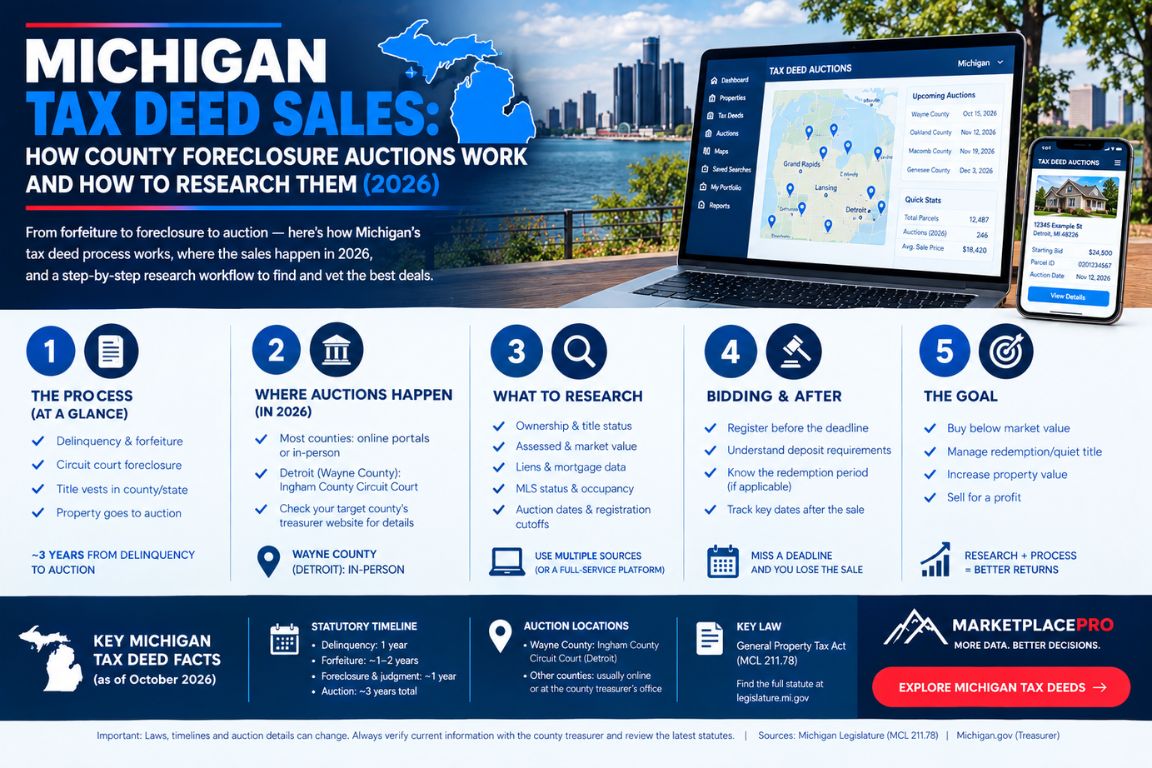
If you are researching a Michigan tax deed sale, start with the fact that trips up most out-of-state investors: Michigan does not run a classic tax lien certificate sale or a simple county deed sale. Delinquent parcels move through a statutory forfeiture and foreclosure process, a circuit court judgment vests title in the foreclosing county treasurer (or the state), and only then does the property go to auction. The auction is the last step of a roughly three-year timeline, and the research that protects your capital happens before and around it.
That structure creates the usual county-by-county grind: auction dates on treasurer websites, bid lists on separate platforms, ownership and mortgage data in other systems, and your notes in a spreadsheet that stops matching reality by week two. Miss one registration cutoff and the sale closes without you.
This guide explains how the process runs under the General Property Tax Act, where the auctions happen as of October 2026, how Wayne County runs its sale, and a repeatable workflow to vet parcels before you bid. Every legal point links to its source.
What Is a Michigan Tax Deed Sale?
A Michigan tax deed sale is a public auction of a property that a county treasurer, or the State of Michigan, foreclosed for unpaid real property taxes. The governing law is the General Property Tax Act, 1893 PA 206 (MCL 211.78 et seq.). The office that forecloses is the foreclosing governmental unit, or FGU: the county treasurer, or the state in counties that elect state foreclosure, per MCL 211.78.
Michigan Treasury describes the result as a three-year forfeiture and foreclosure process: parcels are forfeited to the county treasurer in the second year of delinquency, and taxes still unpaid on March 31 in the third year are foreclosed. Our guide to tax lien states vs tax deed states shows where each model applies.
How the Michigan Tax Foreclosure Timeline Works
The calendar is set by statute, so once you know the sequence you know when inventory forms and when to be registered.
1. Forfeiture on March 1
On March 1 each year, property that is delinquent for the preceding 12 months or more is forfeited to the county treasurer for the total unpaid taxes, interest, penalties, and fees. The treasurer adds a $175 fee per property and records a certificate of forfeiture with the register of deeds within 45 days, per MCL 211.78g. Forfeiture is not yet foreclosure, and the owner can still redeem.
2. Petition for foreclosure by June 15
By June 15 the FGU files a single petition with the circuit court listing every forfeited, unredeemed parcel. The court sets a hearing, and the FGU may withhold certain properties, such as those held by minor heirs or owners in documented hardship, or those under a payment plan, under MCL 211.78h. Owners can contest the petition on limited grounds, such as a tax that was already paid or a description that was void, under MCL 211.78k.
3. Judgment and the redemption deadline
The circuit court enters judgment no later than March 30, effective March 31 for uncontested cases. Redemption rights expire on that March 31 (or 21 days after judgment in a contested case). Under MCL 211.78k, the judgment vests fee simple title in the FGU and extinguishes liens and existing interests, with listed exceptions: visible or recorded easements and rights-of-way, private deed restrictions, certain oil and gas interests, future installments of special assessments, and certain environmental restrictions. Your research should hunt for exactly those exceptions.
4. Government gets the first look
Before the public sees a parcel, the state has a right of first refusal through the first Tuesday in July, followed by the city, village, or township, then the county, under MCL 211.78m. Parcels a government buyer takes skip the auction.
5. The auction window
From the third Tuesday in July through the first Tuesday in November, the FGU or its agent holds one or more auctions, which may be conducted on an internet website. Notice must be published at least 30 days before a sale.
Milestone | Statutory timing | Source |
|---|---|---|
Forfeiture | March 1, for taxes delinquent 12+ months | |
Foreclosure petition filed | By June 15 | |
Judgment and redemption expiry | Judgment by March 30; redemption ends March 31 (21 days if contested) | |
State first refusal | Through first Tuesday in July | |
Auction window | Third Tuesday in July to first Tuesday in November | |
Former-owner claims for remaining proceeds | Notice by July 1 after the foreclosure takes effect |
Dates reflect the statute as published on the Michigan Legislature site in October 2026. Section 78g was amended as recently as July 2026, so confirm current text before you plan around a date.
Stop Tracking Foreclosure Dates by Hand MarketplacePro puts auction dates, bid lists, and deadline tracking for 343,000+ tax lien and tax deed opportunities in one workspace, so a registration cutoff never slips past you. |
What a Winning Bidder Gets and Owes
The sale rules in MCL 211.78m shape your budget and risk.
Minimum bid. Property sells to the bidder at the minimum bid or, if bids exceed it, the highest amount above it.
Payment. The FGU requires full payment at the close of each day's bidding or within 21 days of the sale, so have funds ready before you bid.
Current taxes. You must show proof that any property taxes owed at the time of sale were paid. If they are not paid within 21 days, the sale is canceled.
Affidavit. Before a deed issues, you sign an affidavit under penalty of perjury that you do not hold more than a minimal interest in other tax-delinquent property in that county and that you owe no unpaid blight-type civil fines in that local unit.
Deed. The FGU conveys the deed within 14 days after full payment. The deed vests fee simple title unless the FGU discovers a defect in the foreclosure or cancels the sale.
Where Michigan Tax Foreclosure Auctions Happen (as of October 2026)
There is no single statewide Michigan auction. Each FGU decides how and where to sell, so a tax sale auction in Michigan means checking who the FGU is for each county you want to bid in.
FGU / Operator | What the official source says |
|---|---|
Wayne County Treasurer | Runs its own online auction site for tax-foreclosed properties. Auctions are held in September and October of the year foreclosed, per the Wayne County Treasurer. |
State of Michigan (Treasury) | Auctions tax-foreclosed properties on behalf of 12 counties each summer, per the Michigan Department of Treasury, and uses Tax-Sale.info for those sales. |
Other county treasurers | Each county that acts as its own FGU chooses its format and schedule. Confirm dates, platform, and registration rules on the county treasurer's site. |
Wayne County Tax Deed Sale: What the 2026 Cycle Shows
A Wayne County tax deed sale runs through the county's own auction page. As of October 2026, the Wayne County Treasurer's auction site listed properties published August 14, with registration through September 10 and online bidding starting September 8, and bidding batches closing September 16 and 17. The site shows 2,685 properties in Detroit alone.
Key rules posted on the Wayne County auction site and Treasurer's Claims and Auctions page:
Deposits: $2,500 for a single-property bid, $10,000 for multiple-property bids, and possibly $25,000 for a premium property, each with a $50 non-refundable registration fee.
Minimum bid: all delinquent taxes, penalties, and interest.
Deed type: a quit claim deed, which transfers whatever interest the county holds without warranties.
Condition: sold "as is" and "where is," with buyers told to research special assessments, environmental issues, and demolition status.
Blight check: a deed will not issue if you have unpaid civil fines for local ordinance or blight violations, and the site links to the City of Detroit blight ticket lookup.
Two rounds: unsold September properties are offered again in October.
Rules and dates change every cycle, so treat this as a snapshot and confirm with the Wayne County Treasurer before you register.
How to Research Michigan Auction Parcels Before You Bid
Once the hammer falls, the work you did before registering is all you have. This workflow keeps it in one place instead of ten browser tabs.
1. Build your county calendar first
List each county you can bid in and its FGU, then load every sale window and registration cutoff in one place. MarketplacePro's auction calendar and instant bid lists show upcoming sales so you can plan deposits ahead, and opportunity tracking keeps registration and payment deadlines visible.
2. Filter the inventory to your buy box
Narrow by county, auction date, size, and distress signals, so a long list becomes a shortlist you can underwrite. Our guide to how to find tax-delinquent properties covers the upstream steps, and a good tax sale property search tool does the filtering for you.
3. Confirm foreclosure status and minimum bid at the source
Check the county's official list for each parcel: is it in the auction, and what is the minimum bid? The county site is the source of truth.
4. Pull ownership, value, tax, and lien data together
A foreclosure judgment clears most liens and interests, but not all of them. For each parcel on your shortlist, review ownership, assessed and market value, tax history, mortgage and lien data, and MLS status. With tax deed research in MarketplacePro, all of that sits on the same record, which collapses hours of county-hopping per property into a single focused session and eliminates weak parcels early.
5. Check the exceptions that survive the judgment
Using the exceptions in MCL 211.78k as a checklist, look for recorded easements, deed restrictions, future special assessments, and environmental restrictions. In Wayne County, also check demolition status and blight exposure, because the county tells bidders to research both before bidding. Our due diligence checklist and guide to researching tax liens online give you a template.
6. Verify occupancy, then score the deal and set a walk-away number
Confirm occupancy and condition where you can, and ask a Michigan attorney about removing any occupant. Then add up your bid, the current taxes you must prove paid, special assessments, blight or demolition exposure, and repairs, and compare against value. Deal analysis scoring in MarketplacePro ranks parcels on distress signals, deal economics, and acquisition complexity, which gives you a defensible maximum bid before live bidding starts.
Vet Every Parcel in One Session Ownership, assessed and market value, tax history, mortgage and lien data, MLS status, and distress signals attached to each opportunity, so you decide faster and bid with better visibility. |
Michigan Auctions Compared to Lien and Deed Markets Elsewhere
A Michigan bidder buys the property itself after redemption rights have ended, which is a different risk profile than holding a lien and waiting on redemption. Review tax lien vs tax deed if you are comparing strategies, and see tax lien research if you invest in lien states too. For platform options, see our overview of tax deed software.
Frequently Asked Questions
Does Michigan sell tax liens or tax deeds?
Michigan sells foreclosed properties at auction rather than tax lien certificates. After a circuit court judgment, title vests in the foreclosing governmental unit under MCL 211.78k, and the FGU then sells the property under MCL 211.78m. The buyer receives a deed, but only after a statutory foreclosure process.
When are Michigan tax foreclosure auctions held?
Under MCL 211.78m, auctions run from the third Tuesday in July through the first Tuesday in November after the judgment. As of October 2026, the State of Michigan says it auctions on behalf of 12 counties each summer, and Wayne County holds its auctions in September and October. Confirm the current schedule with the county treasurer.
Can the former owner get the property back after foreclosure?
Redemption rights end on March 31 after the judgment, or 21 days after judgment in a contested case, under MCL 211.78k. After that, the former owner has no redemption right. The Wayne County Treasurer also states that a foreclosed owner cannot buy the property at auction for less than the taxes, fees, and interest outstanding at foreclosure. Former owners may still claim remaining sale proceeds under MCL 211.78t.
How much deposit do I need to bid in Wayne County?
The Wayne County auction site listed a $2,500 deposit for a single-property bid and $10,000 for multiple-property bids in the 2026 cycle, plus a $50 non-refundable registration fee. A premium property may require a $25,000 deposit. Verify these before registering for a future auction.
Which liens and interests survive a Michigan tax foreclosure?
Most liens and interests are extinguished, but MCL 211.78k lists exceptions. They include visible or recorded easements and rights-of-way, private deed restrictions, certain oil and gas interests, future installments of special assessments, and certain environmental restrictions. Confirm each on your parcel with a title search or attorney.
Can I bid on Michigan tax foreclosure auctions from out of state?
Often yes, because MCL 211.78m allows auctions conducted on an internet website and Wayne County conducts its auction online. Registration, deposit, and affidavit rules still apply, and each county sets its own procedures.
Next Steps: Turn the Michigan Calendar Into a Workflow
Michigan rewards organized investors: the dates are fixed by statute, the lists are public, and the surprises hide in the parcel details. Pick your counties, load the sale windows, filter to your buy box, and run every parcel through the same checklist.
The fastest way to see this work is against your own target counties. Book a live walkthrough and we will show current lien and deed inventory, auction calendars, and full property intelligence, or View Demo on your own time.
Related reading: Tax Lien States vs Tax Deed States | Tax Deed Software | Tax Lien Due Diligence Checklist
Research Michigan Parcels Before the Next Sale Filter by county, auction date, size, and distress, then track every deadline in one workspace so you bid with better visibility and fewer missed opportunities. |
Platform & Research Disclaimer MarketplacePro™ is a research and workflow software platform. It aggregates and organizes publicly available property, auction, and tax data to support due diligence — it does not provide financial, legal, tax, or investment advice, and does not guarantee the accuracy, completeness, or timeliness of any data. Tax lien and tax deed investing involves risk, including the potential loss of principal. Always verify information against official county and court records, and consult a qualified financial, legal, or tax professional before bidding or investing. |