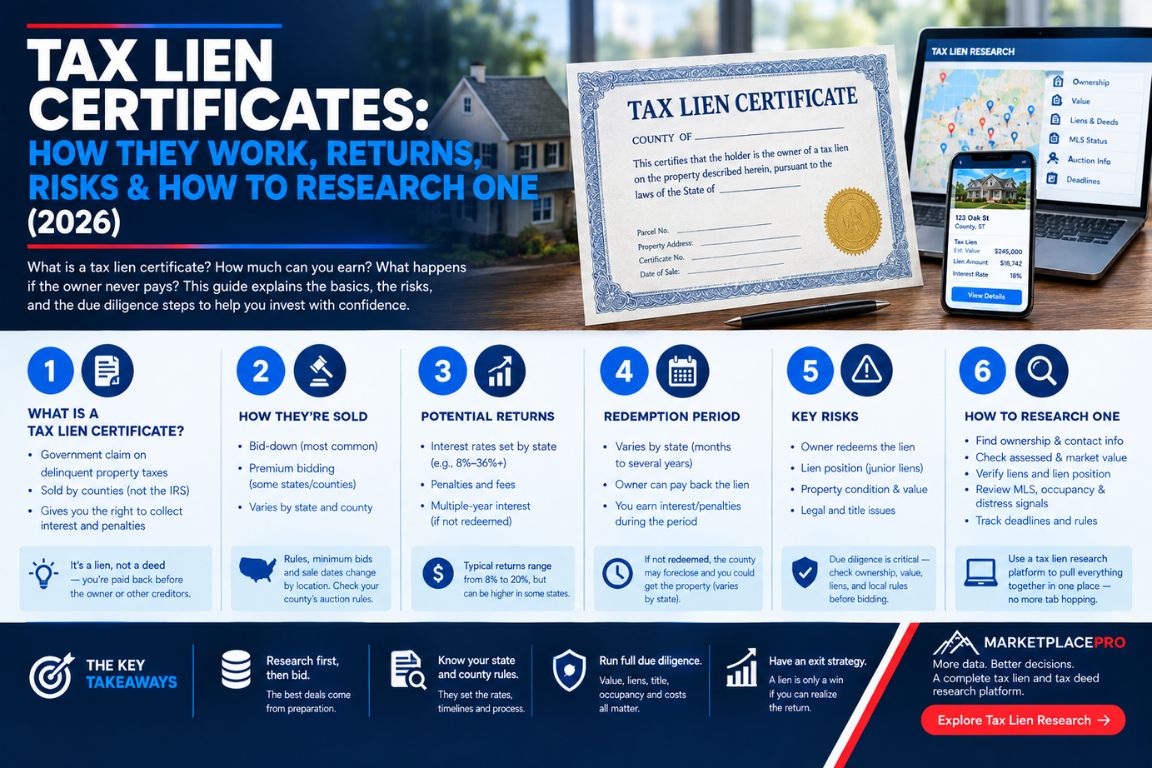
If you are trying to understand a tax lien certificate, you have probably run into the same wall most new investors do: every explanation sounds simple until you ask a specific question. What does the county actually sell? What do you earn, and who sets that number? What happens if the owner never pays? The answers change from state to state, sometimes from county to county, and the details live on clunky county websites, in statute text, and in auction rules that nobody bundles together for you.
This guide closes that gap. It explains what a certificate is, how counties sell them (bid-down versus premium bidding), what the holder can earn, how redemption works, what happens when a lien is not redeemed, and the due diligence that protects your capital. It is a research-and-risk guide, not a registration walkthrough. Every state figure is tied to a current statute or official source, and anything we could not verify is labeled "confirm with the county."
The certificate is the easy part. The research behind it is where investors protect themselves, and where the hours disappear: ownership, value, lien position, MLS status, and deadlines scattered across a dozen tabs. That is the problem tax lien research software is designed to remove, and we will show where it fits as we go.
What Is a Tax Lien Certificate?
A tax lien certificate is a document a county or municipality issues to an investor who pays an owner's unpaid property taxes at a tax sale. In exchange, the investor holds a claim against the property for the amount paid plus the return set by state law or by the bidding. The investor does not buy the property. The owner keeps title, and usually keeps using the property, while the certificate sits as a lien on it.
You will also see it called a property tax lien certificate, a tax sale certificate, or a certificate of purchase. The names differ, and so do the rules, but the structure is consistent:
The investor fronts the taxes. The buyer pays the delinquent amount (and in some states a premium on top) so the county collects immediately.
The owner can redeem. Redeeming means paying back the taxes plus the statutory interest or penalty, which clears the lien and pays the holder.
If the owner does not redeem, the lien can mature. Depending on the state, that can lead to a foreclosure action or a tax deed application, and outcomes vary widely.
That last point is why a certificate is not a savings product. It is a secured claim against real property, with a return that depends on who bids, a timeline that depends on state law, and a downside that depends on the property. For the contrast with deeds, see our guide to tax lien vs tax deed investing.
What a Certificate Is Not
A certificate is not a deed: you generally cannot occupy, rent, or sell the property while the owner can still redeem. It is not a guaranteed return: the rate is set at the sale or by statute, and quick redemptions cap what you collect. And it is not risk-free because "the property secures it": the security is only as good as the property's value, its lien position, and the steps you complete correctly if redemption never happens.
Stop Researching County by County MarketplacePro indexes 343,000+ tax lien and tax deed opportunities across all 50 states, so you can compare certificates in one place instead of hunting through county sites and spreadsheets. |
How a Tax Lien Certificate Sale Works
Every tax lien certificate sale follows the same arc, even though the calendar, bidding method, and platform vary. Each stage produces data and deadlines you will need to track.
1. The Taxes Go Delinquent
An owner misses the tax deadline, and interest and penalties begin accruing under state law. In Florida, real property taxes bear interest at 18 percent per year from delinquency until a certificate is sold, under Florida Statutes 197.172. Arizona sets delinquent interest at 16 percent per year simple under A.R.S. 42-18053.
2. The County Notices and Advertises the Sale
Counties notify owners and publish the parcels offered, usually as PDFs, spreadsheets, or auction-platform pages that differ in every county. For a faster way to build that list, see how to find tax delinquent properties.
3. Bidders Register and Compete
Counties typically require registration and often a deposit. In Florida, the tax collector may require a reasonable deposit, and a bidder who fails to pay a winning bid can be barred from further bidding, per Florida Statutes 197.432. As of October 2026, confirm the current sale date, platform, registration cutoff, and deposit rules with the county.
4. The Winning Bidder Pays and Receives the Certificate
The winner pays the taxes, interest, and costs (plus any premium) and receives the certificate. The clock then starts on the owner's redemption window and on your own deadlines, such as the earliest date you may apply for a deed or file a foreclosure action.
5. The Owner Redeems, or the Lien Matures
Most certificates end with a redemption payment. The rest move down a state-specific path toward a tax deed or foreclosure, covered below. These dates are statutory and easy to miss, which is why opportunity and deadline tracking beats a spreadsheet.
Bid-Down vs Premium Bidding: How Counties Sell Tax Lien Certificates
The bidding method determines what you earn, what you risk by overbidding, and how competitive a sale will be. Knowing which structure applies is the first fact to establish for any sale.
Bid-Down Interest Bidding
In a bid-down interest sale, the statute sets a maximum interest rate and bidders compete by offering to accept less. The bidder willing to take the lowest rate wins the certificate. Florida works this way: each certificate goes to the person who pays the taxes, interest, costs, and charges and demands the lowest rate of interest, not above the 18 percent maximum, with bids accepted only in quarter-point (0.25 percent) increments under Florida Statutes 197.432. If nobody bids, the certificate is struck to the county at the maximum rate. Arizona also awards liens to the bidder who accepts the lowest interest rate, capped at the statutory rate, under A.R.S. 42-18114.
The practical effect is that competitive certificates can be bid well below the maximum. A headline rate such as "18 percent" describes the ceiling, not what you will necessarily earn, so ask what rate comparable parcels in the sale clear at.
Bid-Down Penalty Bidding
Illinois uses a variation. Instead of an interest rate, bidders compete on a penalty percentage: the person offering to pay the amount due for the least penalty percentage becomes the purchaser, and no bid may exceed a penalty of 9 percent of the tax, per 35 ILCS 200/21-215. That penalty then steps up in six-month periods the longer the property goes unredeemed, which we work through in the earnings section below. The statute was amended effective July 10, 2026, so confirm the current text and any county-specific rules before relying on older summaries.
Premium Bidding
In a premium-bidding sale, bidders compete by paying more rather than accepting less. Colorado is the clearest example: the lien goes to the person who pays the taxes, delinquent interest, and fees, or who further pays the largest amount in excess of them, and that excess is credited to the county general fund, per C.R.S. 39-11-115. The investor then earns the statutory redemption interest on the amount paid for the lien, but the premium itself is a cost that does not come back through redemption.
New Jersey uses a hybrid. Bids start at the maximum interest rate of 18 percent and are bid down, and when the bid falls below 1 percent, bidders may instead offer a cash premium, according to the state's Commission of Investigation report on tax sales. That report notes premiums are generally returned to the investor on redemption, but not if the lien ends in a completed foreclosure. New Jersey legislation introduced in 2026, Senate Bill 2052, would change the premium and foreclosure framework. As of October 2026, confirm the status of that bill and the municipality's current sale terms before bidding.
Which Method Is Better?
Neither, in the abstract. Bid-down sales cap your upside at the rate you accept. Premium sales can cost real money if you overbid and the lien redeems quickly. In both, research quality, not bidding enthusiasm, drives results. For states not covered here, the county treasurer's sale rules control.
What You Actually Earn on a Tax Lien Certificate
This is the section most guides get wrong, usually by quoting the statutory maximum as if it were the expected return. We make no return promises here and none should be assumed. What we can do is show how the earnings mechanics work, so you can model a specific certificate yourself.
The Return Is Set by Bidding and by Statute
Your return comes from an interest rate you bid, a penalty percentage you bid, or a statutory redemption rate that applies regardless of the bid. It is shaped by how long the certificate stays open, any premium you paid, county fees, and later years' taxes you pay on the same parcel, which often earn interest of their own.
Worked Examples of the Mechanics
These examples are arithmetic that illustrates how statutes work. They are not forecasts, and actual outcomes depend on your bid, your county, and the redemption date.
Florida and the 5 percent minimum. Under Florida Statutes 197.472, when interest earned is less than 5 percent of the face amount, a mandatory minimum of 5 percent applies, except on a certificate bid at 0 percent, which earns no interest. A $1,000 certificate bid at 2 percent and redeemed within a few months pays a $50 minimum. The tax collector also receives a $6.25 fee per redeemed certificate, and the holder is paid the redemption amount less that fee.
Illinois and stepped penalties. Under 35 ILCS 200/21-355, the penalty at redemption is the certificate amount times the penalty bid, times the number of six-month periods that have started since the sale, up to six. A $2,000 certificate amount bid at a 6 percent penalty and redeemed in the second period yields 12 percent, or $240; redeemed in the first six months, $120. The statute also notes a nonrefundable $80 fee per item bought at sale.
Iowa and monthly interest. Iowa Code section 447.1 sets redemption interest at 2 percent per month, counting each fraction of a month as a full month from the month of sale, so the exact redemption date within a month changes what you collect.
Maryland and Colorado. Maryland's redemption rate is set by statute: Tax-Property 14-820 provides 6 percent a year in most counties, higher in some, and no more than 10 percent on owner-occupied residential property. Colorado redemption interest is nine percentage points above the Kansas City Fed discount rate, rounded to the nearest full percent and reset each October 1, under C.R.S. 39-12-103, so confirm the current rate with the treasurer.
The Costs That Reduce a Headline Rate
The rate is only the top line. Subtract what applies to you:
Time value of capital. Money in a certificate cannot be redeployed until it comes back, and you do not control when.
Fees and premiums, such as Florida's $6.25 redemption fee, Illinois's $80 fee, or a Colorado premium.
Taxes on the income. Interest received is generally taxable; see IRS Topic no. 403, Interest received and ask a tax professional how it applies to you.
Research and tracking costs, including your own hours.
At the zero-return end, a Florida certificate bid at 0 percent earns nothing, and a New Jersey premium win earns no bid interest. Those are legitimate choices for investors who want the property outcome, but they are a different risk profile and should be chosen deliberately.
Redemption: How Most Tax Lien Certificates End
Redemption is the owner's right to clear the lien by paying what the statute requires. It is a common outcome, and it is the one that pays you. The amount, timing, and window all come from state law.
What the Owner Pays
To redeem, the owner (or someone with a legal claim, such as a mortgage lender) generally pays the amount for which the lien was sold, plus the interest or penalty, certain costs, and any later taxes you paid. Illinois lists the components in 35 ILCS 200/21-355. In Florida, the person redeeming pays the face amount plus interest, costs, and charges, and the tax collector pays the certificate owner within 15 business days of receipt, per Florida Statutes 197.472.
How Long the Owner Has
Redemption windows vary a great deal:
Illinois: property sold at a tax sale may be redeemed any time before three years from the date of sale, with a one-year period for vacant non-farm property, structures with seven or more residential units, and commercial or industrial property, per 35 ILCS 200/21-350.
Arizona: a lien may be redeemed within three years of the sale, and after three years until a treasurer's deed is delivered, per A.R.S. 42-18152.
Florida: a certificate may be redeemed at any time after issuance and before a tax deed is issued, per Florida Statutes 197.472.
Colorado: redemption may be made any time before the treasurer's deed is executed, per C.R.S. 39-12-103.
Iowa: the holder may serve a notice of expiration of the right of redemption starting after one year and nine months from the date of sale, and the owner then has 90 days from completed service, per Iowa Code 447.9.
In some states the window is a fixed number of years. In others the right to redeem continues until a deed issues or a court decree cuts it off. Your money is tied up while the window is open, and you do not control how long that is.
What Happens If a Tax Lien Certificate Is Not Redeemed?
This question separates liens from fixed-income products, and the answer is "it depends on the state." After the redemption window closes, the holder's remedy is generally one of two paths: apply for a tax deed, or file a court action to foreclose the owner's right to redeem.
The Tax Deed Application Path
Florida is the best-known deed-application state. After two years have elapsed since April 1 of the year the certificate was issued, the holder may file the certificate and a tax deed application with the tax collector, per Florida Statutes 197.502. That starts a statutory process and does not make you the owner. The holder also faces a clock: under Florida Statutes 197.482 a certificate is canceled seven years after issuance if no deed application or other proceeding is on record.
Iowa runs a notice-then-deed process: the treasurer issues a deed on an unredeemed parcel when the holder returns the certificate and pays the fees, and the holder must do so within ninety days after the redemption period expires or the certificate is canceled, per Iowa Code 448.1. Colorado allows the holder to demand a treasurer's deed three years after the sale if the lien is unredeemed and notice requirements are met, per C.R.S. 39-11-120.
The Foreclosure Path
Other states require the holder to sue. In Arizona, beginning three years after the sale and not later than ten years after the last day of the month the lien was acquired, the holder may bring a superior court action to foreclose the right to redeem, per A.R.S. 42-18201. The statute includes an excess-proceeds mechanism: a court may order the property sold if it is likely to bring more than $2,500 above specified amounts, which protects the owner's equity. The published text is marked effective until October 1, 2028, a sign these rules are being revised.
Maryland shows how hard the rules can punish an inactive holder. A holder may file a foreclosure complaint after six months (nine for owner-occupied residential property) and must first send required notices, per Tax-Property 14-833. The certificate is void unless foreclosure is filed within two years of the certificate date, and a void certificate forfeits the holder's interest and all money paid on the sale. A holder who does not act in time can lose the entire purchase price.
New Jersey permits a Superior Court foreclosure action after a set period, which the state's reform legislation describes as two years from the date of sale. As of October 2026, confirm timing and pending changes with the municipality and a New Jersey attorney.
Why Outcomes Vary and Why Equity Matters
The end of the path is not a windfall. In Tyler v. Hennepin County (2023), a unanimous U.S. Supreme Court held that a county that sold a home for $40,000 to satisfy roughly $15,000 in tax debt and kept the $25,000 surplus plausibly violated the Takings Clause. States are revising surplus and foreclosure rules in response, so treat any "you get the property for the price of the taxes" claim with suspicion.
Outcomes also depend on what is on the property. A low-value lot, a deteriorated structure, or surviving senior liens can leave a holder owning a problem, which is why the due diligence section below carries most of the weight in this guide.
Track Every Redemption Window and Deed Deadline Keep sale dates, registration cutoffs, redemption windows, and application deadlines visible in one workspace so a missed date never costs you the position. |
Tax Lien Certificates by State: A Comparison (as of October 2026)
The table below compares seven states using only figures we verified from current statute text or official state sources. It is a research starting point, not a substitute for the county's own sale rules. Rates, windows, and procedures are amended regularly, so confirm each figure with the county treasurer or tax collector before you bid. Where we could not verify a detail, the cell says "confirm with the county."
State | How certificates are awarded | What the holder earns | Redemption and foreclosure timing | Primary source |
|---|---|---|---|---|
Florida | Bid-down interest, quarter-point increments, capped at 18% per year | The bid rate; a 5% minimum applies on redemption unless the bid was 0% | Redeem any time before a deed issues; holder may apply for a tax deed after 2 years from April 1 of the issue year; certificate expires after 7 years without a deed application | |
Illinois | Bid-down penalty percentage, no bid above 9% of the tax | Penalty bid times the number of started six-month periods, up to six periods | 3 years from sale; 1 year for vacant non-farm, 7+ unit residential, and commercial or industrial property | |
New Jersey | Bid-down interest from an 18% cap; premium bids when the rate falls below 1% | The bid rate, or no bid interest on a premium win | Foreclosure action after about 2 years; confirm with the municipality, as reform legislation is pending | |
Arizona | Bid-down interest, capped at the statutory delinquent rate (16% per year) | The bid rate | Redeem within 3 years or later until a deed is delivered; foreclosure action from 3 years after sale up to 10 years after acquisition | |
Colorado | Premium bidding; excess over taxes and fees is credited to the county general fund | Statutory rate of 9 percentage points above the Kansas City Fed discount rate, reset each October 1 | Redeem before the treasurer's deed; deed available after 3 years if unredeemed | |
Iowa | Confirm with the county treasurer | 2% per month; a partial month counts as a full month | Notice of expiration may be served after 1 year 9 months; owner then has 90 days | |
Maryland | Confirm with the county collector | 6% per year in most counties, higher in some, capped at 10% for owner-occupied residential | Foreclosure complaint after 6 months (9 for owner-occupied); certificate void if no foreclosure filed within 2 years |
States appear here because they illustrate a mechanism, not as recommendations, and a rate cap is not a rate you will earn. To compare lien states against deed states, our guide to tax lien states vs tax deed states maps where each system applies.
Tax Lien Certificates in Florida: A Closer Look
Florida draws the most search interest for tax lien certificates Florida, and chapter 197 of the Florida Statutes is unusually clear, so it works as a model of how the pieces fit.
How Florida Awards Certificates and What They Pay
Each county tax collector sells certificates on delinquent real property to the bidder who pays the taxes, interest, costs, and charges and demands the lowest interest rate, up to 18 percent per year, in quarter-point steps. Ties are resolved by the method the tax collector selects, and an unsold certificate is struck to the county at the maximum rate. Sales may be electronic and may allow proxy bidding, so platforms vary by county. The holder earns the bid rate, subject to the 5 percent minimum on redemption (except 0 percent bids), paid through the tax collector. See Florida Statutes 197.432.
What Happens If No One Redeems
The holder may apply for a tax deed two years after April 1 of the issue year, and the certificate expires after seven years without an application. Florida also bars sale of a certificate under $250 on homestead property at auction; it is issued to the county at the maximum rate. That kind of detail is why a parcel-level check beats a rule of thumb. As of October 2026, confirm sale dates, platforms, and fees with the specific county tax collector.
The Risks of Tax Lien Certificates
The category's reputation for safety comes from one fact: a lien is secured by real property. The protection is real, but it is conditional. These are the risks that matter, and the research that addresses each.
Redemption Risk and Opportunity Cost
A quick redemption returns your capital early but may pay little. A certificate that stays open for years ties up capital with no way to accelerate the outcome. Either way, timing is not yours to control.
Property Risk
If the lien does not redeem, you may be on the path toward the property or its sale proceeds, which is only attractive if the property is worth the lien. Unusable land, a structure needing heavy repair, environmental problems, or a lot worth less than the taxes can turn a certificate into a loss. An address and a tax roll do not show you condition.
Lien Position and Senior Claims
In many states, property tax liens take priority over private mortgages, but not every claim behaves the same way. Federal tax liens, some municipal liens, and certain easements can complicate the picture, and which liens survive depends on state law. Mortgage and lien data belongs on the same record you evaluate, not in a title search you run after you buy.
Procedural and Deadline Risk
Maryland's void-certificate rule and Florida's seven-year expiration show that a missed statutory date can forfeit the position. Iowa and Maryland also require specific notices before a deed or foreclosure can proceed, and errors can invalidate the process.
Competition and Bidding Risk
Competition can push bid-down rates toward the floor and premiums upward. Investors who lose money here usually did not misread the statute. They overpaid to hold a certificate on a weak parcel.
Data and County Error Risk
County records contain mistakes: wrong owners, missed payments, parcels that should not have been sold. Illinois, for one, provides a remedy for erroneous sales, but avoiding the problem is cheaper. Verify each parcel against official county and court records before bidding.
Legal and Regulatory Change Risk
Illinois amended its penalty and redemption sections effective July 10, 2026. Arizona's foreclosure provisions carry an October 1, 2028 effective-until date. New Jersey has reform legislation pending. A strategy built on last year's rules may not match this year's statute.
How to Research a Tax Lien Certificate Before You Bid
Research is where most of the time goes, and where most of the protection comes from. Here is a structured way to evaluate a certificate, with the data points that matter at each step. The aim is to eliminate weak parcels fast so your attention goes to the ones worth the capital.
1. Confirm the Sale Rules for That County
Establish the bidding method, maximum rate, registration and deposit rules, payment deadline, and platform. Write down the redemption window and the earliest date you could apply for a deed or file a foreclosure action. Everything else depends on these facts.
2. Verify Ownership and Occupancy
Identify the owner of record, whether the property looks owner-occupied, and whether a mortgage lender may pay the taxes to protect its position. Ownership data also tells you who must be notified before any foreclosure or deed step proceeds.
3. Compare Assessed Value, Market Value, and the Lien Amount
A lien that is a small fraction of the property's value is better secured than one close to it. Check MLS status too: a listed property suggests the owner may sell and the lien may be paid at closing.
4. Review the Tax and Delinquency History
A first-time delinquency behaves differently from a parcel delinquent for years or one that has cycled through multiple tax sales. Repeat delinquency can signal an owner who cannot or will not pay, raising the odds the lien matures.
5. Check Mortgage and Lien Position
Identify recorded mortgages and other liens, and know which survive a tax foreclosure or deed in that state. Cross-check county recorder and court records, because an aggregator is a starting point and the official record is the authority.
6. Assess Property Condition and Land Use
Use imagery, assessor data, and distress and opportunity signals to see whether the parcel is a buildable lot, an occupied home, a deteriorated structure, or unusable land. Check zoning, access, and municipal violations.
7. Model the Outcomes, Not Just the Rate
Estimate what you collect if the lien redeems in three months, in two years, and not at all, net of fees, premiums, and your costs. If the numbers only work on the best-case redemption date, you have a bet on timing, not a researched position.
8. Set Your Deadlines Before You Bid
Enter every governing date into a tracker before you bid: sale, payment, earliest deed or foreclosure date, notice deadlines, and expiration or void dates. Our tax lien due diligence checklist covers these steps, and how to research tax liens online moves the workflow online.
Where the Time Goes
Done manually, those steps mean visiting a treasurer site, an appraiser site, a recorder or clerk site, an MLS portal, and your spreadsheet for every parcel. That is the 3+ hours per property that sinks most research plans. MarketplacePro puts ownership, assessed and market value, tax history, mortgage and lien data, and MLS status on one record, so you can eliminate failing parcels in a single focused session. Deal scoring then ranks what remains.
How Do You Buy Tax Lien Certificates? The Short Version
This guide is about research and risk, and the mechanics of buying tax lien certificates are county-specific, so we keep this short. In general: find the counties and sale dates that fit your criteria, register with the county or its auction platform, fund the deposit, research the parcels, bid within the rules, and pay by the deadline. Florida's tax collector, for example, may require a deposit and set a 48-hour payment window, per Florida Statutes 197.432.
Where investors go wrong is treating registration as the hard part. The sale ends a process that starts weeks earlier with list-building and research. For tools that support it, see tax sale property search, the tax lien investing app guide, how to choose a tax lien data provider, and tax lien software cost.
Where MarketplacePro Fits in a Certificate Research Workflow
MarketplacePro is a research and workflow platform. It does not buy certificates for you or replace the county's official records. It removes the busywork between "this parcel is on a sale list" and "I have enough verified information to decide":
343,000+ opportunities across all 50 states, so your buy box is set by your criteria, not the counties you happen to know.
Centralized search and filters by auction date, size, distress, and county, so a national inventory narrows to a shortlist in minutes.
Full property intelligence, so underwriting happens on one record instead of five websites.
Auction calendar and instant bid lists, so you arrive at a sale with an organized list instead of a pile of PDFs.
Distress signals, deal scoring, and deadline tracking, so you spend time on parcels worth the capital and keep every date visible.
A built-in buy and sell marketplace, so you can later list what you hold to other investors.
The promise is practical: faster decisions, better visibility, and fewer missed opportunities. It does not change the statute, the risk, or your obligation to verify each parcel. If you also work in deed states, the same workflow applies to tax deed research, and our guide to tax deed software explains what to look for. You can view the demo before talking to anyone.
See Your Target Counties in One Workflow Search 343,000+ opportunities, attach full property intelligence, score the deals worth your capital, and track every deadline, all from one platform. |
Frequently Asked Questions
What is a tax lien certificate in simple terms?
A tax lien certificate is a document a county issues to an investor who pays a property owner's unpaid property taxes at a tax sale. The investor holds a lien for the amount paid, and the owner repays it, with interest or a penalty set by state law or the bidding, to clear the lien. The investor does not buy the property, and the owner generally keeps title during the redemption period.
Do you own the property when you buy a tax lien certificate?
No. You own a lien against the property, and the owner keeps title unless the lien goes unredeemed and you complete a state-specific process such as a tax deed application or court foreclosure. That process has its own notices, deadlines, and costs, and outcomes vary by state.
How do you buy tax lien certificates?
You register with the county or its auction platform, fund any required deposit, bid at the tax sale under the county's rules, and pay by the deadline. Details differ by county and change between sales. As of October 2026, confirm registration cutoffs, deposits, and payment deadlines with the county tax collector or treasurer.
What is the difference between bid-down and premium bidding?
In bid-down bidding, bidders offer to accept a lower interest rate or penalty and the lowest bid wins, as in Florida, Arizona, and Illinois. In premium bidding, bidders pay more than the taxes owed, as in Colorado, where the excess goes to the county general fund. New Jersey is a hybrid: bids go down, and below 1 percent bidders may offer a cash premium.
How much do tax lien certificates pay?
It depends on the state's rate mechanism, the winning bid, and how long the certificate stays open, so no single number applies. Statutory maximums such as 18 percent in Florida or 16 percent in Arizona are ceilings, and competitive bidding can bring rates well below them. Fees, premiums, and zero-percent bids can reduce or eliminate the return, so model each certificate individually.
What happens if a tax lien certificate is not redeemed?
The holder can generally pursue a tax deed application or a court foreclosure, depending on the state. Florida lets the holder apply for a deed two years after April 1 of the issue year, while Arizona allows a foreclosure action beginning three years after the sale. Notices, deadlines, and owner-equity protections apply, so the result is not simply "you get the property."
Can you lose money on a tax lien certificate?
Yes. Risks include an unrecovered premium, a lien on property worth less than the taxes, a missed statutory deadline, and legal changes that affect your remedy. In Maryland, a certificate is void if foreclosure is not filed within two years, and the money paid on the sale is forfeited. Research and deadline tracking reduce these risks but do not remove them.
How do tax lien certificates work in Florida?
County tax collectors sell certificates on delinquent real property to the bidder who accepts the lowest interest rate, up to 18 percent per year, in quarter-point steps. A 5 percent minimum applies on redemption unless the bid was zero percent. The holder may apply for a tax deed two years after April 1 of the issue year, and the certificate expires after seven years without an application.
How long does a tax lien certificate last?
It depends on the state. A Florida certificate expires seven years after issuance without a deed application. In Arizona the holder may bring a foreclosure action up to ten years after acquiring the lien, and in Maryland the certificate is void unless foreclosure is filed within two years. The owner's redemption window may be fixed or may run until a deed or decree issues.
Is a tax lien certificate a good investment for beginners?
That depends on how much research you can do and how much risk you can accept, and nothing here is investment advice. The category rewards investors who verify ownership, value, lien position, and deadlines parcel by parcel and penalizes those who chase headline rates. A structured process, a few well-understood counties, and professional guidance put a beginner in a stronger position than bidding on volume.
Next Steps: Turn Research Into a Repeatable Process
You now have the framework: know the bidding method, understand what the rate does and does not promise, map the redemption and foreclosure path, and verify every parcel before you bid. The remaining question is how to do that without spending three hours per property. To see how a centralized workflow handles your target counties, book a live walkthrough and we will show current lien and deed inventory in the states you care about, with full property intelligence attached. Prefer to look around first? Start with tax lien research or watch the demo.
Related reading: Tax Lien vs Tax Deed | How to Research Tax Liens Online | Tax Lien Due Diligence Checklist
Platform & Research Disclaimer MarketplacePro™ is a research and workflow software platform. It aggregates and organizes publicly available property, auction, and tax data to support due diligence — it does not provide financial, legal, tax, or investment advice, and does not guarantee the accuracy, completeness, or timeliness of any data. Tax lien and tax deed investing involves risk, including the potential loss of principal. Always verify information against official county and court records, and consult a qualified financial, legal, or tax professional before bidding or investing. |